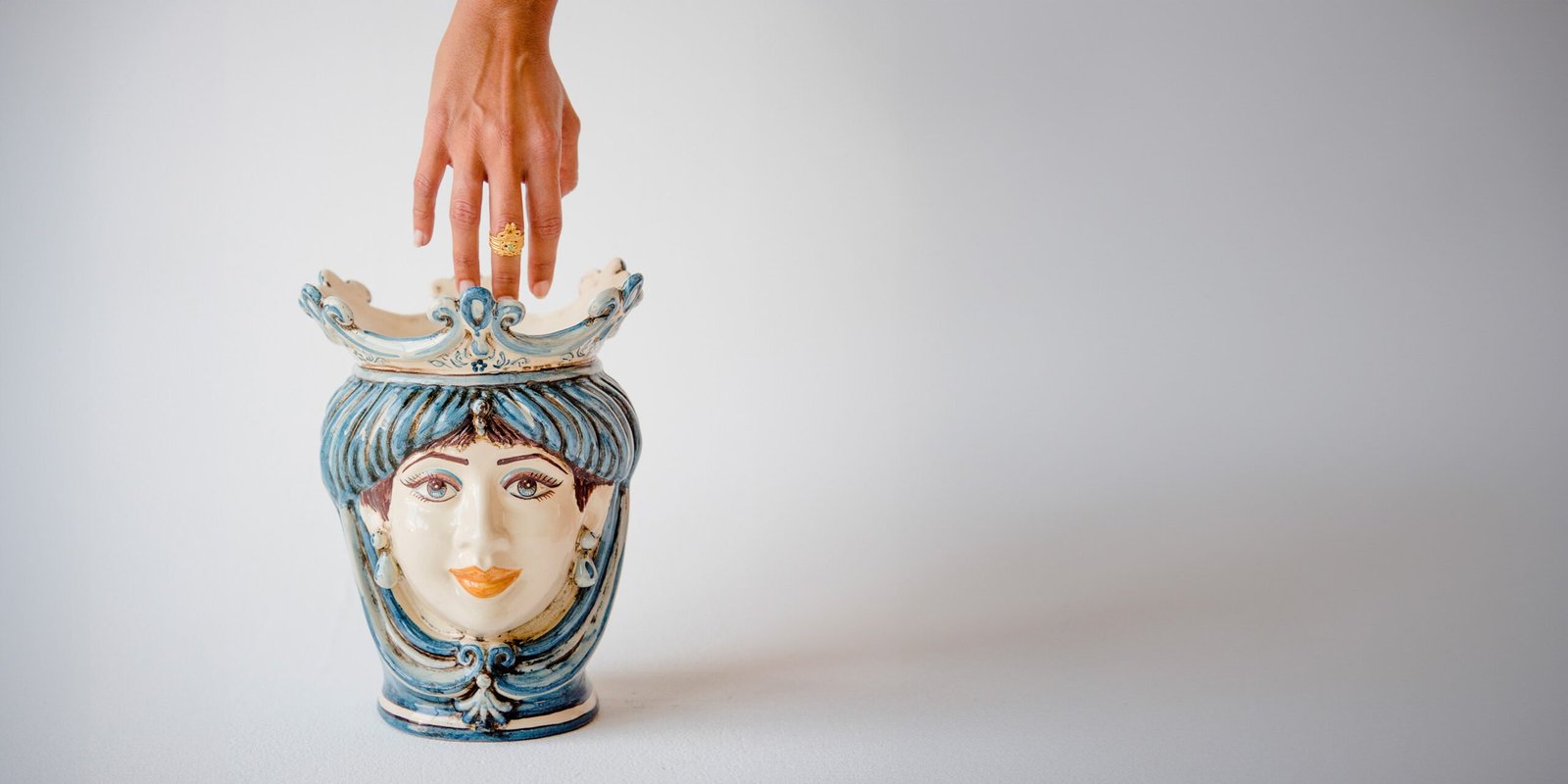
A Sicilian pinecone — a pigna in Italian — is a glazed ceramic pine cone that stands for prosperity, health, and a welcoming house. In Sicily it goes on gateposts, balcony corners, and the top of outside stairs, and it is one of the standard gifts for a wedding or a new home. Indoors it usually lands where guests see it first: an entry console, a mantel, the head of a staircase.
What the pigna stands for
Three ideas come up again and again, and they overlap rather than compete. A cone is a seed container — dozens of seeds packed under the scales — so it reads as fertility and abundance. The stone pine (Pinus pinea) stays green through winter and its wood is resinous and slow to rot, so it also reads as health and long life. And because the piece sits at the threshold, it works as a message to whoever arrives: this house is doing all right, and you are welcome in it.
That last reading is why pigne are given at weddings and housewarmings, often in pairs, one for each gatepost. Some families pass them down. We have repaired pieces that were bought two generations before the person carrying them into our workshop.
The older history is less tidy than most product listings make it sound. Pine cones appear in Roman ornament, on the thyrsus carried in the rites of Dionysus, and as a Roman bronze roughly four meters tall that now stands in a Vatican courtyard. Whether any of that runs in a straight line to a Caltagirone potter, we can’t tell you — that link is usually asserted and rarely shown. What is solid is narrower: the pigna has been a staple of Caltagirone production for generations, alongside the moor’s heads and the painted water jugs.
How we make a pigna in Caltagirone
Caltagirone has been a pottery town for a very long time; its best-known public surface is the 142-step staircase of Santa Maria del Monte, whose risers were faced with painted tiles in the 1950s. The clay we work is a local earthenware body, red to buff after firing.
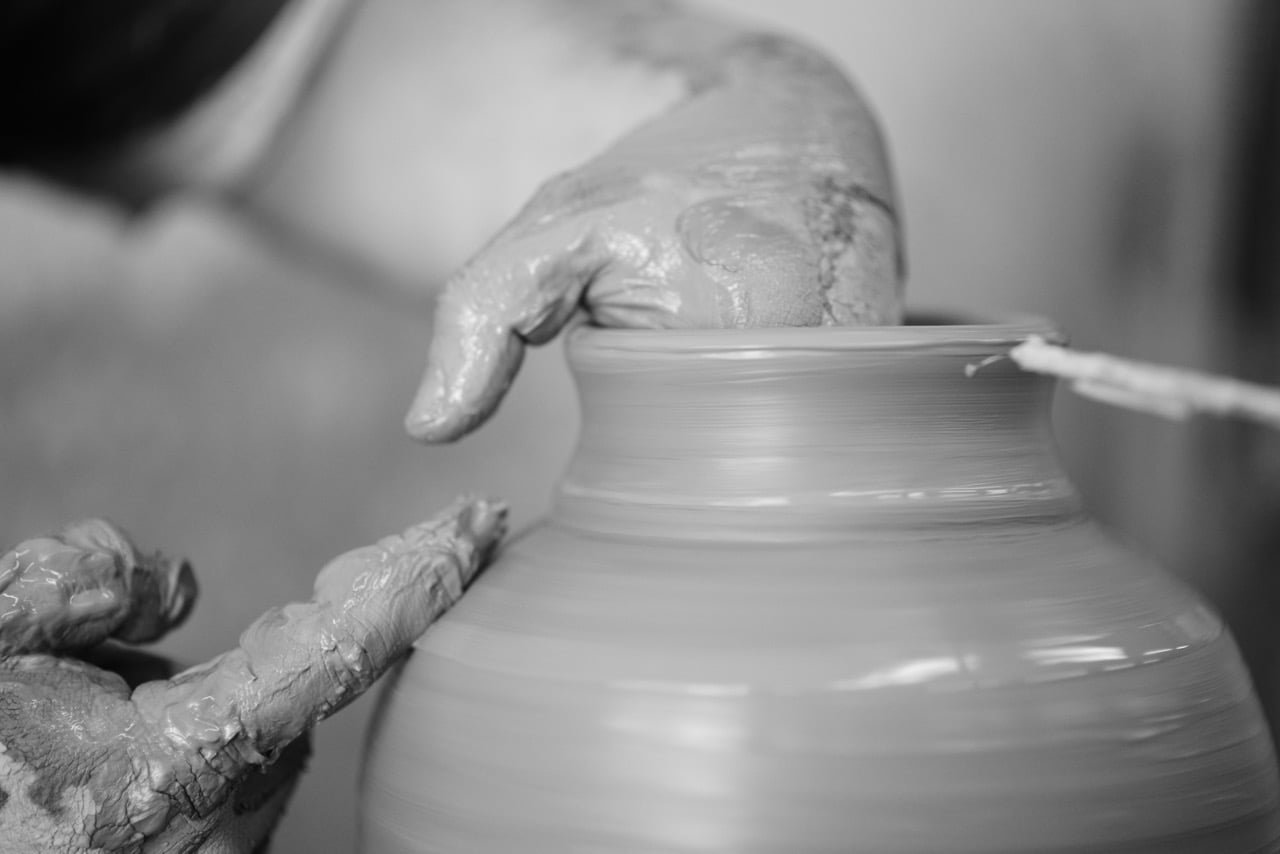
A pigna is built one of two ways. Small and medium pieces are often thrown on the wheel as a hollow ovoid and closed at the top, with the scales either carved into the leather-hard surface or applied one at a time as small pads of clay. Larger pieces are pressed in a two-part plaster mold and then finished by hand. A mold is not a shortcut to be ashamed of — potters have used them for centuries — but it does mean the seam and the scale tips need cleaning up by hand before the piece is worth anything.
Then it dries slowly, five to twelve days depending on wall thickness and season, longer in a damp winter. We fire twice. The first firing, the biscotto, runs to about 980–1000 °C (roughly 1,800–1,830 °F) and leaves a porous, chalky piece. That gets dipped in a white glaze, which dries to a powdery surface, and the painting happens directly on that powder with metal-oxide pigments: cobalt for blue, copper for green, antimony for yellow, manganese for brown and black outlines. The powder absorbs the color instantly. There is no erasing and no correcting — a wrong line means starting the piece over. The second firing, around 920–950 °C (about 1,690–1,740 °F), melts the glaze and sinks the color into it.
Clay shrinks roughly 8–12% between wet and fired, which is why catalog measurements refer to the finished piece. It is also why two pigne from the same mold, painted the same morning by the same hand, will differ in the width of a line and the depth of a blue. That is the honest trade-off of hand painting, not a defect to be apologized for.
Sizes, and what each one is actually for
Weights below are what we typically see in our workshop; they vary with wall thickness.
- 10–15 cm (4–6 in), about 0.3–0.7 kg — bookshelves, a desk, a bathroom ledge, table settings, and the size that travels safely in hand luggage.
- 20–25 cm (8–10 in), about 1.5–2.5 kg — the most useful indoor size: entry console, mantel, dining table centerpiece.
- 30–40 cm (12–16 in), about 3–6 kg — floor beside a door, a garden wall, a gatepost cap, a landing.
- 50 cm (20 in) and up — pillars and formal entrances. Heavy enough that the surface underneath has to be flat, level, and solid.
If the pigna is going on a post, measure the top of the post before you choose. The foot of a 30 cm piece is often 10–13 cm across, and a cap of about 25 cm square gives it a stable seat with a visual margin. A base wider than the cap looks wrong and catches wind.
Colors, and what they mean for durability
The traditional Caltagirone palette is cobalt blue, copper green, antimony yellow, and manganese brown on a white ground. Blue-and-white is the calmest and the easiest to place in a room you didn’t decorate around it. Green, yellow, and manganese together look the most archaic. Full polychrome is the loudest. Solid turquoise or plain white pigne, with the shape doing all the work, sit better in a contemporary interior.
The durability difference matters more than most buyers realize. Those four oxides are fired at full glaze temperature, so they end up locked inside the glass and will not fade in sun. Bright red, coral, pink, and gold are a different story: they are usually on-glaze enamels or luster applied in a third firing at around 700–750 °C (1,290–1,380 °F), sitting on top of the glaze. They wear with handling, they don’t belong in a dishwasher or a microwave, and we would not put a gold-lustered pigna outdoors at all.
Where to place a Sicilian pinecone
Indoors
The entry table is the traditional spot and still the best one — it keeps the original meaning intact. On a mantel, either one large piece placed off-center or a matched pair at the ends; a pair in the middle reads like a mistake. As a dining centerpiece, keep the total height including any stand under about 30 cm so people can see each other across the table. On a shelf, allow the foot diameter plus about 5 cm of depth, or it will look perched.
One lighting note from years of photographing these: a glossy tin glaze bounces a hard hot spot straight back at a ceiling downlight, and the piece flattens out. Light it from the side or at an angle instead, so the scales throw shadows. The modeling is most of what you paid for.
Outdoors and on gateposts
Pairs on gateposts, single pieces at balcony corners, either side of a door, along a garden wall, at the top of exterior steps. To fix one, a few beads of neutral-cure silicone on a clean, dry cap will hold it against wind and can still be cut free with a blade later. Lime or cement mortar is permanent, which also means you can never bring the piece in for winter — think about that before the mortar goes down.
Don’t set a pigna directly on soil or on a surface where water pools. The foot is unglazed and wicks moisture straight into the clay body. Two small pads or a flat stone underneath solve it.
Frost, sun, and everyday care
Earthenware is porous under the glaze, and that single fact explains almost every pigna that dies young. Crazing — a fine web of lines in the glaze surface — is normal in maiolica and is not a manufacturing fault, but outdoors it is a way in for water. Water inside the body expands when it freezes, and the result is a crack through the wall or glaze flaking off in flat chips.
These pieces are made in a climate where hard frost is unusual. If your winter goes below freezing — most of the US north of the mid-Atlantic, plus the cold nights that reach the UK — bring the pigna into a shed or a hallway from late fall. Cleaning is warm water, mild dish soap, and a soft cloth. No abrasive pads. No bleach on a crazed glaze, because it soaks into the body and can weep back out later as brown staining. Dry the foot before you put it back. Our fuller notes on dishwashers, chips, and stain removal are in our guide to caring for Sicilian ceramics.
What to check before you buy
Look at the boundary where two colors meet. A brush leaves a slightly uneven edge and a heavier deposit where the stroke started; a printed decal is perfectly even, and under a 10x loupe often resolves into a dot pattern. Then compare the two sides of the same piece — hand work varies from one side to the other, printing does not. A faint vertical seam up the side tells you a mold was used and nothing more.
Turn it over. The foot should be an unglazed ring showing the clay body, and some workshops sign or stamp it; an unmarked foot is not proof of anything in either direction. Ask direct questions before you pay: is there gold or on-glaze red on this piece, is it meant to live outside, and how is it packed? The scale tips are the first thing to chip in transit and should be protected inside a double box. For marks, materials, and how to tell a working workshop from a reseller, see our buyer’s guide to Caltagirone ceramics.
And set your expectations properly: a pair of hand-painted pigne are siblings, not twins. If you need two objects that match to the millimeter, hand-painted maiolica is the wrong material.
Frequently asked questions
What does a Sicilian pinecone symbolize?
Fertility and abundance, from the seeds packed under the scales, and health and longevity, from the evergreen tree itself. Placed at an entrance it also functions as a sign of welcome and of a prosperous household, which is why it is such a common wedding and housewarming gift in Sicily.
Can I leave a ceramic pigna outside through the winter?
Only where hard frost is rare. Earthenware stays porous under the glaze, so water gets in through the unglazed foot or through crazing, freezes, and cracks the piece. In a climate with freezing nights, bring it indoors or into an unheated shed from late fall and keep the foot off wet ground the rest of the year.
Should I buy one pigna or a pair?
A pair is the traditional choice for gateposts or for flanking a door, and it is what tends to be given to newlyweds. Indoors, a single larger piece placed off-center usually looks better than a symmetrical pair on the same shelf. Remember that hand-painted pairs will differ slightly.
How can I tell whether a pigna is hand-painted?
Check the edges of the brushwork for uneven boundaries and a heavier deposit at the start of each stroke, then compare the front and back of the same piece for small differences. Perfectly identical repeated motifs, or a visible dot pattern under a loupe, point to a printed decal rather than a painter.