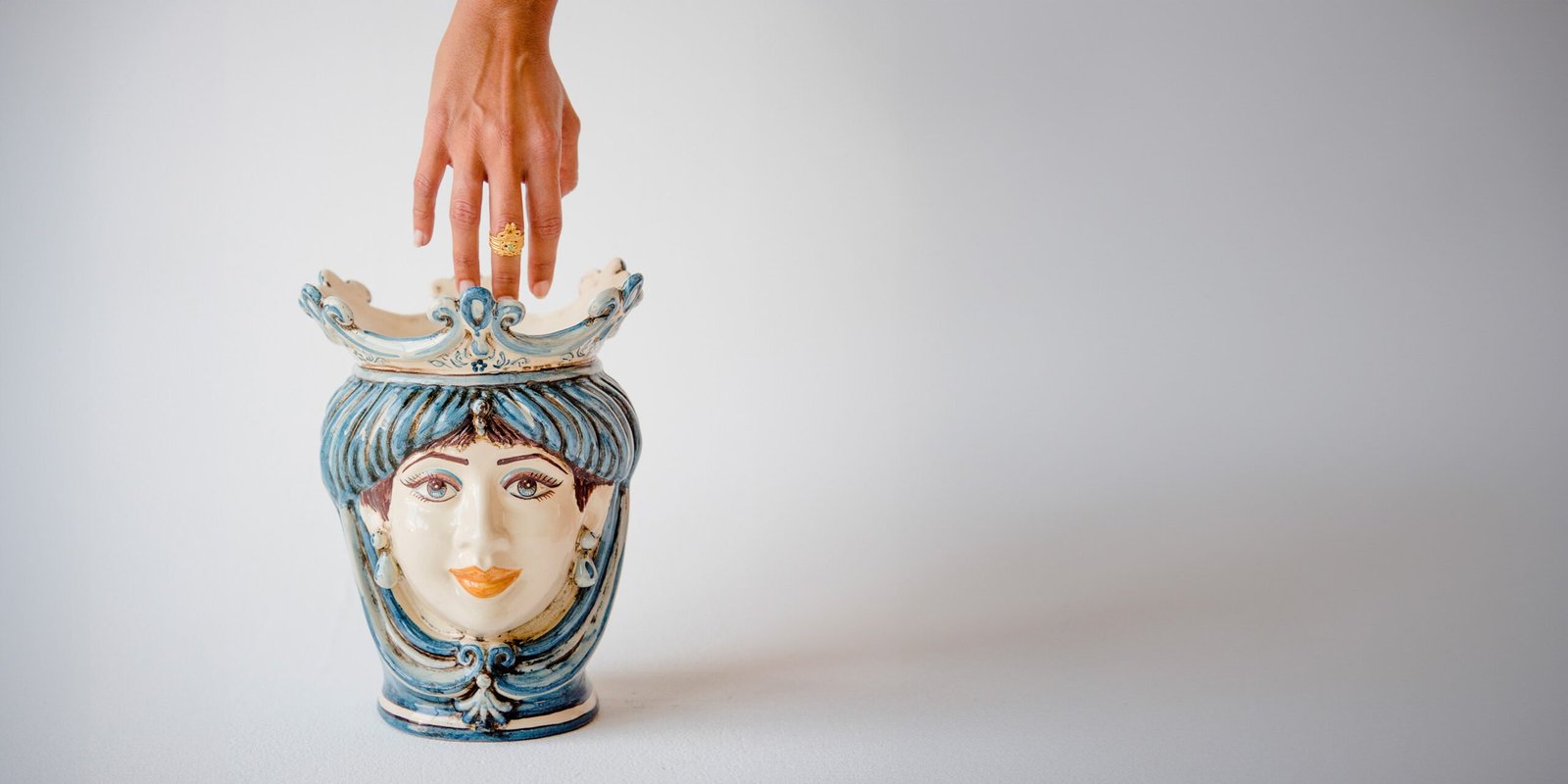
A testa di moro is a hand-painted ceramic head, usually made as a pair — one man, one woman — and used as a planter or as a piece that stands on its own. The shape comes from Sicily, and the story attached to it is a Palermo folk tale about love, betrayal, and a pot of basil. We fire them in Caltagirone, so what follows is both the legend and the workshop version: what the object is, how it gets made, and what to check before you buy one.
The Palermo Legend, in the Version We Were Told
Set the scene around the eleventh century, in the Kalsa, the old Arab quarter of Palermo. A young Sicilian woman spends her days on a balcony tending plants. A young Moor passing in the street below looks up, sees her, and the two fall in love quickly and completely, the way people do in stories that end badly.
Then she learns he has a wife and children waiting for him at home, and that he intends to go back to them. That night, while he sleeps, she cuts off his head. She hollows it out, fills it with soil, plants basil in it, and sets it on the balcony rail. The basil grows better than anyone else’s on the street — watered, in most tellings, by her crying. The neighbors notice, get envious, and have terracotta pots made in the shape of heads so their own balconies will look the same.
That is the version we grew up with. There are others. In some, her family kills them both when the affair comes out; in some he is a merchant rather than a soldier; in some both heads are severed, which gets offered as the explanation for why the pieces come in pairs. Guides in Palermo will point you to a specific alley. We wouldn’t put much weight on that. What we can say is that the tale circulated by mouth for a long time before anyone wrote it down, and the written versions we know are recent enough that they tell you more about the nineteenth and twentieth centuries than about the eleventh.

What the Legend Doesn’t Explain
The story is good. It is not an origin document. Vessels shaped like human heads turn up around the Mediterranean long before anyone in Palermo cut off anybody’s head, and Sicilian potters were making figurative jars and anthropomorphic pharmacy vessels for centuries. The specific object most people mean today — a matched pair, a crowned man with a dark face and a crowned woman, painted in maiolica colors — is a much later convention, and a good deal of its standardization is commercial. Workshops settled on a format that sold, and the format stayed.
We can’t tell you the year the first testa di moro was made, and we’re skeptical of anyone who can. What is documented is Caltagirone’s own tradition: the town has produced glazed pottery since antiquity, its name is usually traced back to Arabic — roughly, castle of the jars — and the Arab period brought the glazing techniques that Sicilian maiolica still runs on. The heads sit inside that tradition rather than founding it.
One more thing, since it comes up. Moro in Italian meant a North African, and more loosely anyone dark-haired. The piece depicts a Moor, and the tale attached to it is a murder. Buyers sometimes want to know that before a head goes on their mantel, so we’d rather say it plainly than dress it up.
Reading a Pair: Crown, Turban, Fruit
Most pairs follow a loose grammar. The male head has a darker face and wears either a turban or a crown; the female head is lighter and almost always crowned. Both are often loaded with modeled fruit — lemons, grapes, pomegranates, prickly pear — and the woman usually gets earrings and a painted collar. The color range is the old maiolica palette: cobalt blue, copper green, antimony yellow, manganese brown, iron orange, on an opaque white ground.
None of this is a rule. Contemporary workshops, ours included, make heads in a single color, in plain white, with gold luster on the crown, with a pineapple where the turban should be. If you want the traditional look, the tell is the palette and the density of the painting: the old decoration covers the piece, while modern versions leave white space on purpose.
How We Make a Testa di Moro in Caltagirone
Molds and drying
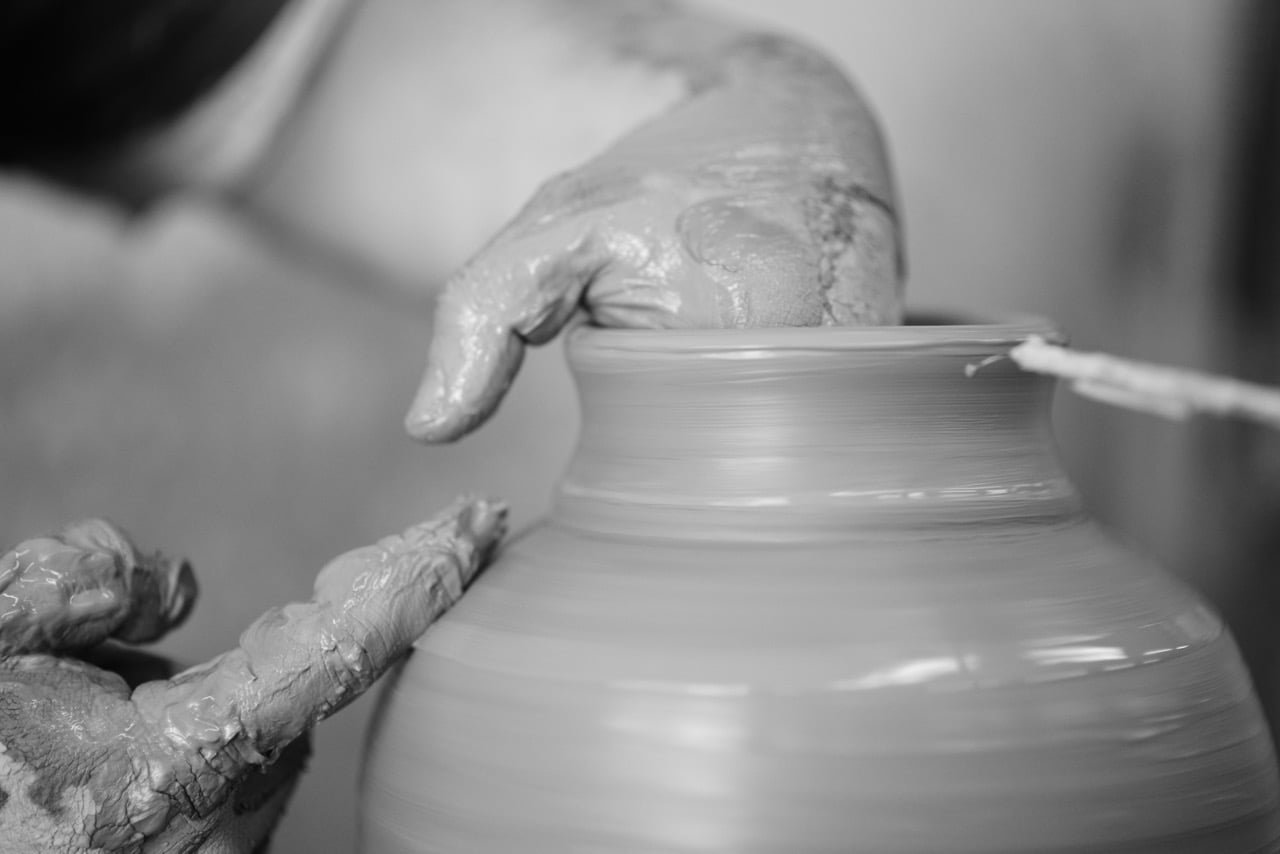
The body is pressed by hand into plaster molds, usually in two halves, at a wall thickness of about 8 to 12 millimeters. The halves are joined with slip, the seam is worked from the inside wherever we can reach it, and then the parts that make the piece specific — crown, curls, fruit, nose, ears — are modeled and attached separately. Drying is slow on purpose: one to three weeks depending on size and season, because a heavy crown drying faster than the neck under it will crack at the join. August here is harder on drying than February.
The first firing
Bisque goes to roughly 1000 °C (about 1830 °F) on a ramp of ten to twelve hours, and then the kiln cools for a full day before we open it. Opening early is the classic shortcut and the classic mistake — thermal shock puts a hairline through a piece that survived everything else.
Painting on raw glaze
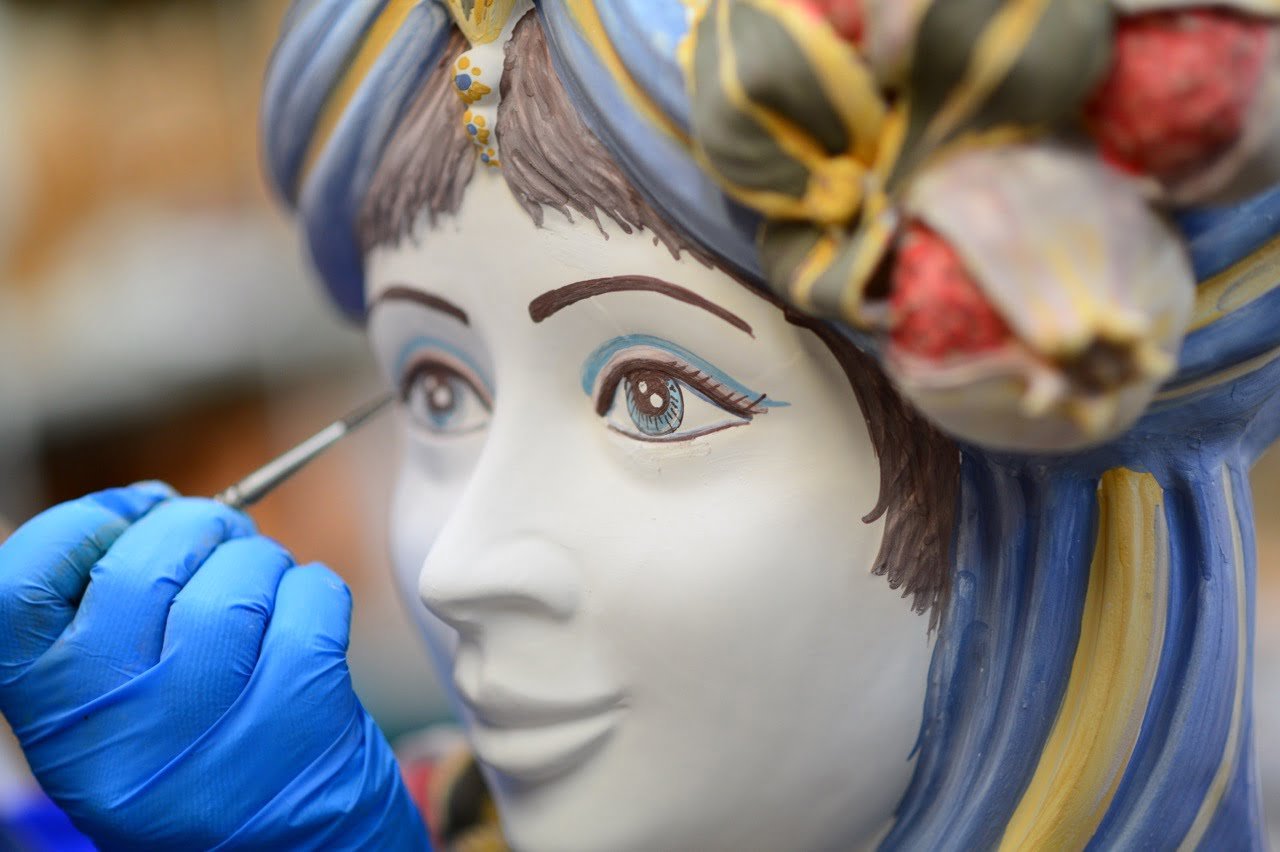
The bisque head is dipped in a tin-white glaze and comes out chalky. Our painters work directly on that raw powder, which takes pigment the way fresh plaster takes fresco color: the stroke is fixed the moment it lands. No wiping back, no correcting. A stroke in the wrong place means scraping the glaze off that whole area and dipping again. The face takes longest to learn. Eyes a millimeter off center change the entire expression, and a painter here will practice faces for years before we let one go into a pair.
The second firing
We fire twice, and the second firing is the cooler one — between 920 and 980 °C, enough to melt the glaze and pull the colors down into it. Gold or luster, if the piece has any, needs a third pass at roughly 700 to 750 °C. Between wet clay and finished head the piece loses something like ten to twelve percent of its size, which is why an empty mold always looks too big.
Size, Weight, and Where One Actually Goes
Heads run from about 15 cm (6 in) up past 60 cm (24 in). The pairs that end up in most homes are 25 to 30 cm — 10 to 12 inches — and a single 30 cm head weighs on the order of 3 to 4 kg (7 to 9 lb) empty. Fill it with wet soil and it is heavier than the floating shelf you were planning to use.
Measure the opening, not just the height. On a 25 cm head the crown opening is often only 8 to 10 cm across, which takes a small basil or a succulent and nothing more. Ask whether the base is drilled, too: plenty of heads are made as ornaments and have no drainage hole at all. If yours doesn’t, keep the plant in its nursery pot and use the head as a cachepot — it’s what most people end up doing anyway. Our buyer’s guide to Caltagirone ceramics goes further into sizing, matching pieces, and what to ask a workshop before you commit.
Telling Hand-Painted from Printed
The fastest check on a pair is to compare the same detail on both heads: the same leaf, the same eye, the same piece of fruit. If they match exactly, a person did not paint them. Hand-painted heads are siblings, not copies, and ours differ from each other by design.
- Look at the edge of the color. A brushstroke starts thick and thins out. Printed decoration has a uniform edge and, under a loupe, often breaks into a dot pattern.
- Feel the surface. On maiolica the color is fired into the glaze and the whole piece reads smooth. A decal can sit slightly proud of the surface, or look a little matte against the gloss around it.
- Accept small flaws. Pinholes, a few dark specks, a faint mold seam, a crown that isn’t perfectly symmetrical — all normal, all consistent with a real firing.
- Turn it over. The base should show an unglazed ring, sometimes stilt marks, and a workshop mark or signature. A spotless glazed base with no marks anywhere is worth a question.
We set this out in more detail in our five checks for identifying authentic Sicilian ceramics, which covers plates, tiles, and pinecones as well as heads.
Water, Sun, and Winter
Maiolica is a porous body under a glassy skin. The glaze is waterproof; the unglazed foot is not. Water that soaks into the base and then freezes will lift the glaze off in flakes, and nobody can repair that afterward. In a mild coastal climate a head can live outside year-round. Through a hard freeze — much of the American Northeast and Midwest, or a bad British winter — bring it in, or at the very least empty it, dry it, and get it off wet ground.
Sun is not a problem. The colors are fired into glass above 900 °C and don’t fade, which is the real practical advantage of maiolica over anything painted after firing. Fine crazing, a web of hairlines in the glaze, is common with traditional recipes and is usually cosmetic rather than structural, though it will collect dirt over the years. Clean with a damp cloth and mild soap, no dishwasher, no abrasive pads. And treat a decorative head as decorative: unless a workshop tells you a specific piece meets foodware standards, don’t serve out of it.
Frequently Asked Questions
Should I buy the pair, or just one head?
Traditionally they’re a couple and they’re sold that way, and two read better on a balcony or on a pair of shelves than one does alone. Plenty of people buy a single head. If you think you’ll want the match later, buy both at once — heads are made in batches, and a second head painted two years on by a different hand won’t be a true partner to the first.
Are the two heads supposed to be identical in size?
Within a pair, near enough: same mold family, same kiln load. But hand-modeled crowns and fruit make small differences unavoidable, and shrinkage in a firing is never exactly equal across two pieces. A centimeter between the man and the woman in the same pair is normal, not a fault.
Can I plant directly in a testa di moro?
Only if it has a drainage hole, and even then a liner protects the inside. With no drainage, water pools in the base, the porous body stays saturated, and you get root rot inside and possible glaze damage outside. Dropping a nursery pot in solves both problems at once.
If it says “Sicilian ceramic,” is it made in Caltagirone?
Those are two different claims. “Sicilian style” describes a look and can be applied to a piece made anywhere. Ask where it was formed, where it was painted, and whether the workshop will name the painter. A workshop that fires its own kilns will answer all three without hesitating.