A hand-painted Caltagirone piece passes through eight or nine stages, two firings and several weeks before it is finished, and most of that time is spent waiting rather than working. This page follows a piece from raw clay to the finished object, and explains the one stage that accounts for most of what people notice in the result.
The clay, and why it is aged before anyone touches it
The body is earthenware, dug locally. Raw clay arrives with stones, root matter and pockets of air in it, so it is first refined: slaked down in water, passed through sieves, then left for the heavy impurities to settle out and the excess water to go. What comes back is a plastic clay of even consistency.
Then it is aged, which is the step that looks like nothing happening. Clay left damp for weeks becomes more workable, because water distributes evenly through it and bacterial activity makes it more plastic. A workshop that skips this ends up fighting the material on the wheel.
Immediately before shaping, the clay is wedged, or kneaded. This is not a formality. A single trapped air bubble expands in the kiln and takes the piece with it, so wedging is what decides whether the work survives its first firing.
Shaping: wheel, coil, slab and mold
Four techniques cover almost everything in the repertoire, and which one is used depends on the shape rather than on preference.
- Wheel-throwing. Anything with a circular section: vases, bowls, cachepots, the bodies of lamps. A tall floor vase is usually thrown in two or three parts and joined while the clay is still soft enough to bond.
- Coiling. Long rolls of clay layered and smoothed together. Slower than the wheel, and used for large or asymmetric forms that would collapse under their own weight if thrown.
- Slab-building. Flat sheets cut and assembled. Used for anything with straight sides or a flat back, holy water fonts among them.
- Molding. Liquid clay, or slip, poured into a plaster mold that draws the water out and leaves a shell of even thickness. This is how repeated relief detail is made: the faces and headdresses of the heads, pine cone scales, applied flowers and handles.
Once the form holds its shape, relief and incised detail are added by hand with carving tools, and any separately molded parts are attached with slip.
Drying, the stage nobody photographs
The piece then dries in still air, out of draught and out of direct sun, for days or weeks depending on its size and wall thickness. It passes through leather-hard, when it can still be trimmed and carved, and ends bone dry.
Drying cannot be hurried. Clay shrinks as it loses water, and if the outside contracts faster than the inside the wall splits, usually at a join or where a handle meets the body. A thick-walled floor vase can take several weeks on its own, which is the real reason a large piece has a longer lead time than a small one.
The first firing
The dry piece is fired at roughly 1000°C. This drives off the last chemically bound water and converts the clay irreversibly into biscuit: hard, still porous, and no longer able to return to a plastic state. The porosity is the point, because it is what lets the piece take up glaze in the next stage.
The kiln is brought up and down slowly. A fast rise or a fast cool cracks the work, so a firing cycle including cooling runs over more than a day.
Glaze and painting, on a surface that cannot be corrected

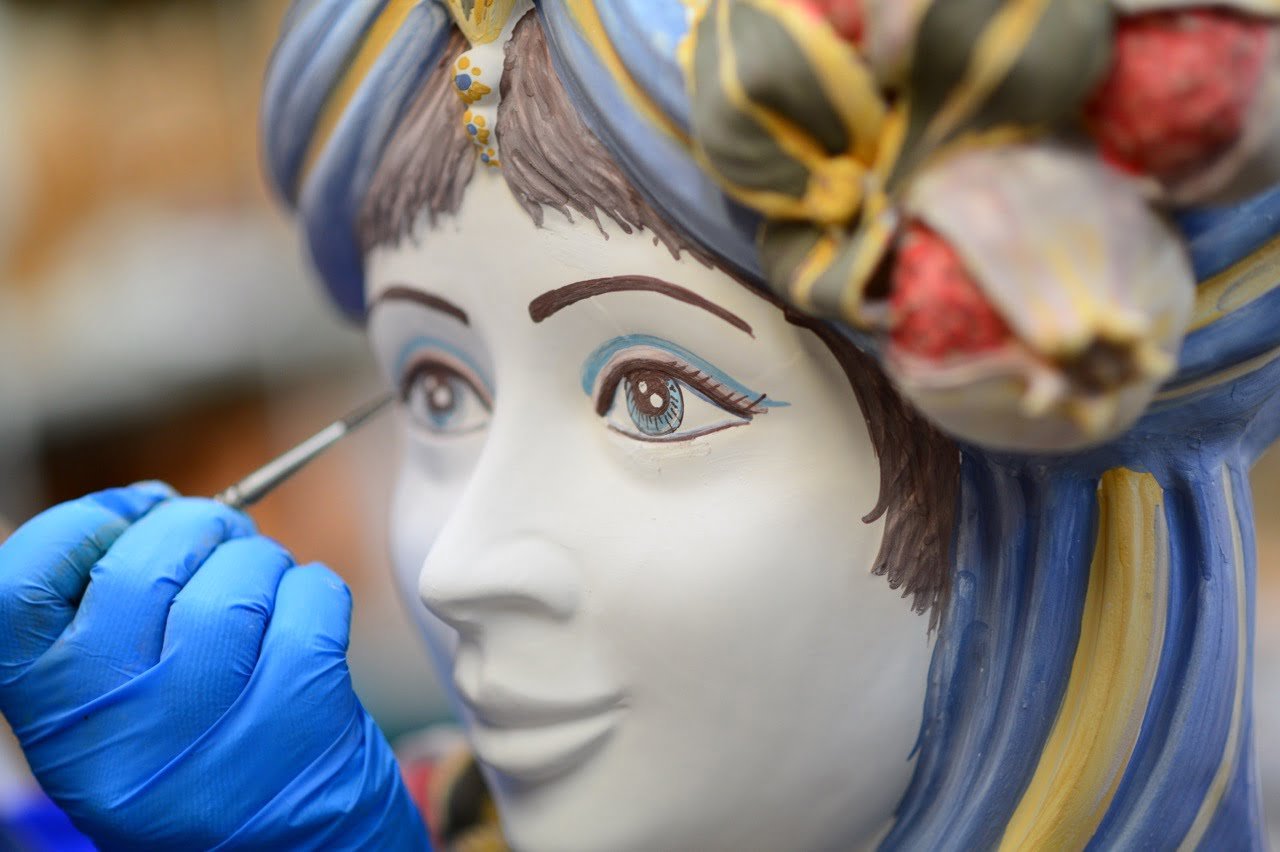
The biscuit is dipped in a white tin glaze. What it comes out with is a dry, chalky, highly absorbent coating, and this is the surface the decoration is painted on. It is also the stage that explains most of what people notice in a finished maiolica piece.
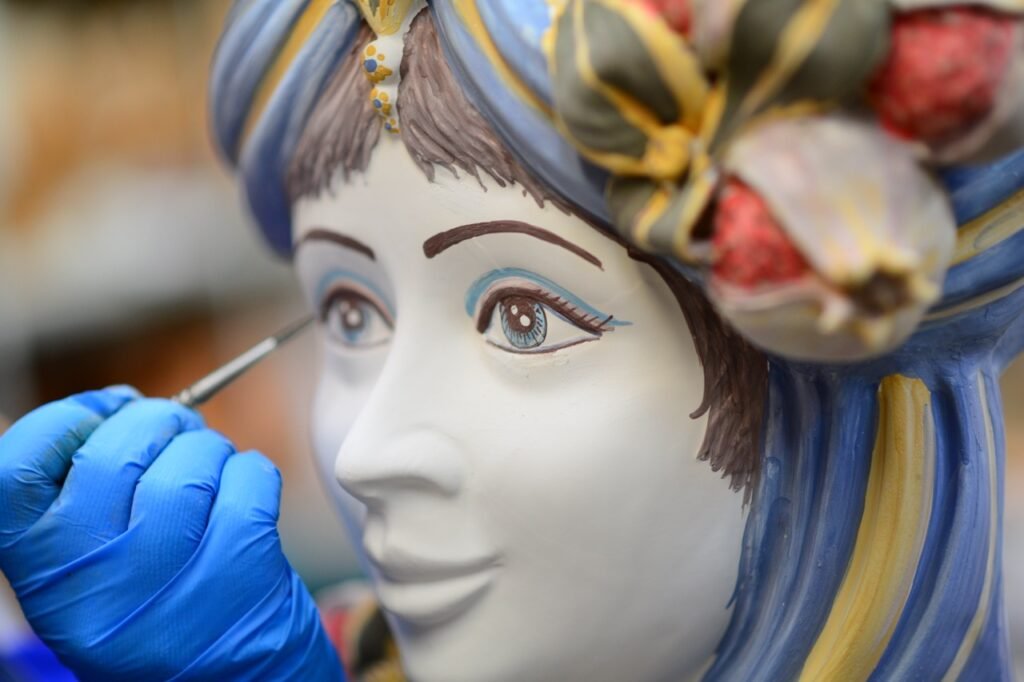
Pigment touched onto raw glaze is absorbed on contact, the way ink is absorbed by blotting paper. It cannot be wiped back, painted over or adjusted. There is no underdrawing to follow and no correcting a line that goes wide: the brush stroke that is made is the brush stroke that is fired. A painter works from memory and repetition, laying in outlines first and filling afterwards, and a large decoration is completed in one sitting because a half-dry passage will not blend with a fresh one.
That constraint is what a hand-painted piece and a printed transfer differ by. On real brush work the line varies in width, the fill shows the direction it was laid in, and the same decoration on two pieces from the same line is recognisably the same and demonstrably not identical. It is the most reliable thing to look at, and we go through it alongside marks, glaze and weight in our guide to identifying authentic Sicilian ceramics.
The second firing
The painted piece goes back into the kiln at around 920 to 980°C. The glaze melts to a glassy layer, the pigments fix into it rather than sitting on top, and the colors change as they mature: what the painter applied was a set of dull greys and pinks, and the blues, greens and yellows appear only here. Reading an unfired piece takes experience, because none of the colors look like themselves yet.
Where gold or luster is used, it needs a third pass at a lower temperature, since those finishes would burn away at glaze-firing heat.
What goes wrong, and why no two pieces match
Every batch loses some work. Trapped air, an uneven join, a draught during drying, a kiln shelf loaded a little too close: any of these show up as a crack or a blister, and they show up after days of work have gone in. The losses are why handmade pieces cost what they do, and they are absorbed before anything reaches a catalog.
Shrinkage also explains something buyers ask about. Clay contracts appreciably between wet and twice-fired, so two pieces made to the same drawing can finish a centimeter apart. Stated dimensions are therefore close rather than exact, which matters if a piece has to fit a specific alcove or shelf.
For the historical side of the craft rather than the making of it, ceramics in Sicily covers where the tradition comes from and why the colors and forms settled as they did. For the practical side, our buyer’s guide to Caltagirone ceramics covers the families of pieces and how to read a listing, and where to buy authentic Sicilian ceramics online explains how to tell a workshop from a reseller. And how to care for Sicilian ceramics explains why a twice-fired glaze crazes, and how to avoid causing it.