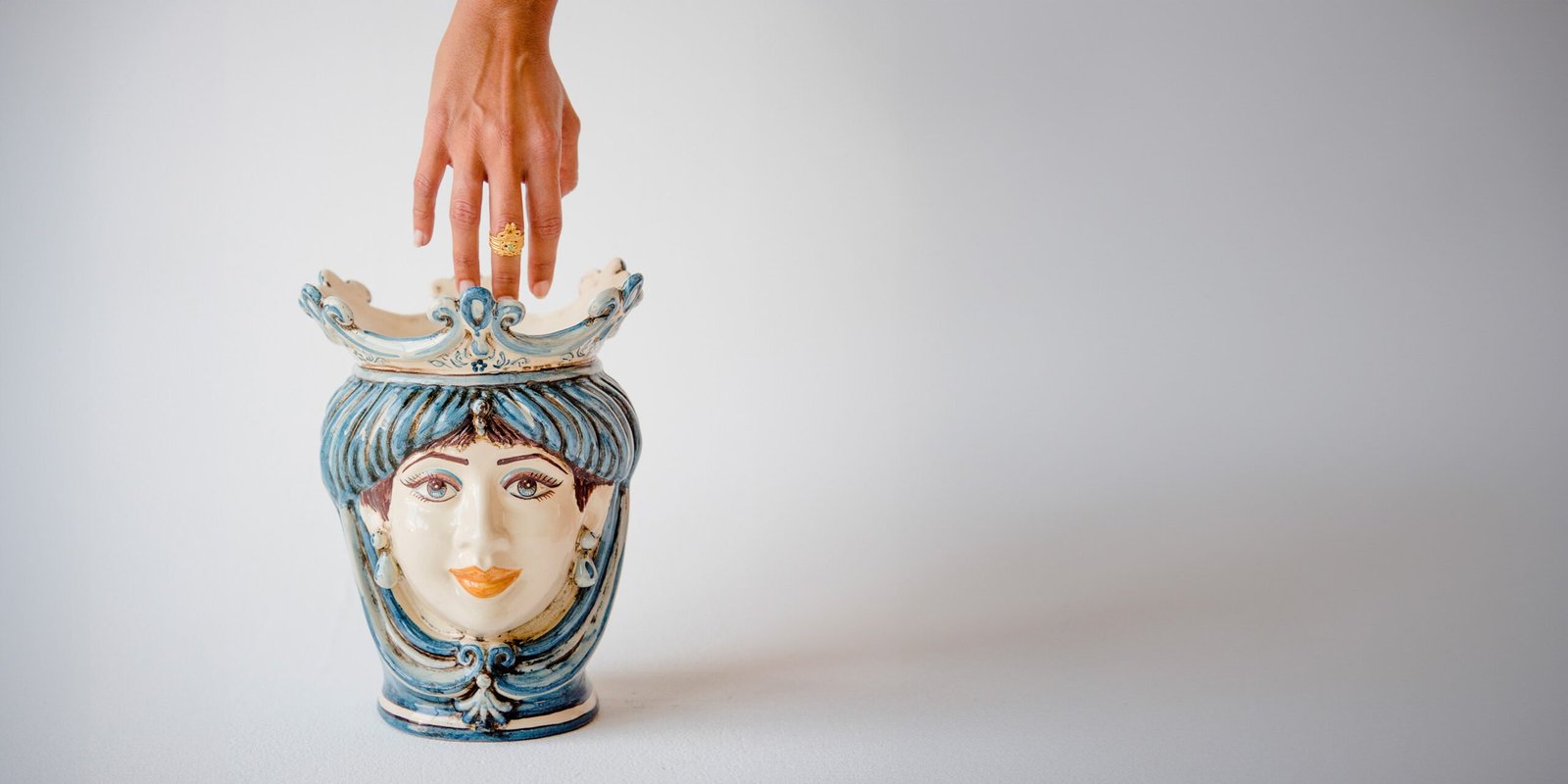
Most Italian ceramic plates sold for the table are tin-glazed earthenware — majolica — and the ones we make in Caltagirone follow a shape catalog that has barely changed in a hundred years. What you actually need to decide is narrower than it looks: diameter, depth of the well, width of the rim, and whether anything metallic was fired onto the surface. Every measurement below comes off pieces that leave our kiln.
Majolica, Not Porcelain: What the Body Changes
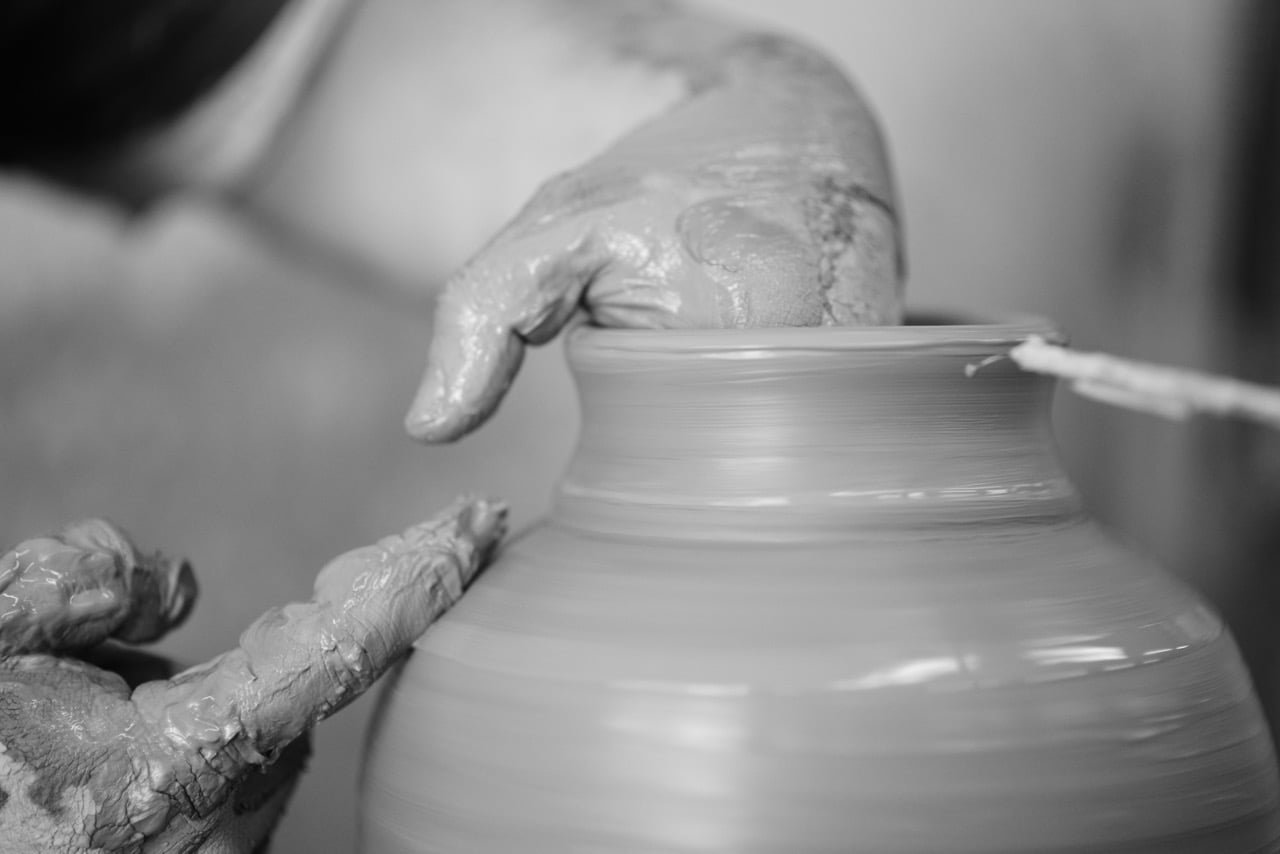
We throw or press our plates in a buff Sicilian clay, dry them for four to seven days depending on the season, then biscuit-fire at about 1000 °C (1830 °F). What comes out is porous and terracotta-color. It goes into a bath of white tin glaze, dries to a chalky powder, and the painting happens on that powder. The second firing, between 920 and 980 °C (1690 to 1800 °F), melts glaze and color into a single skin.
Two consequences show up on your table. The walls are thick — ours run 6 to 9 millimeters against 2 to 4 for porcelain — so a 27 cm dinner plate lands somewhere between 700 and 900 grams. And a chip shows the clay underneath. On white porcelain a small chip nearly disappears; on majolica it reads as a terracotta notch on a white edge, and nothing hides it. If you are still choosing between the two materials, we go through the differences at length in our comparison of Sicilian ceramics in majolica versus porcelain.
The Shapes, by Their Italian Names
Three words make everything else easier to read. The cavetto is the well, the sunken center where food sits. The tesa is the rim around it — wide on a classic Caltagirone plate, 4 to 6 cm, and it carries most of the painting. The piede is the foot ring underneath, the one part we leave unglazed, because a glazed foot would weld the plate to the kiln shelf.
- Piatto piano (dinner plate): 26–28 cm / 10¼–11 in, flat well, shallow.
- Piatto fondo (pasta and soup): 21–24 cm / 8½–9½ in, with a well 3 to 4 cm deep. The Sicilian version is usually wider and shallower than a French soup plate.
- Piatto da dessert, or da frutta: 20–22 cm / 8–8½ in. Doubles as a salad or appetizer plate.
- Piattino da pane (bread plate): 15–17 cm / 6–6¾ in.
- Piatto da portata (round serving platter): 32–40 cm / 12½–15¾ in.
- Vassoio ovale (oval platter): around 40 × 28 cm / 15¾ × 11 in, for fish, roasts, grilled vegetables.
- Insalatiera (salad bowl): 24–28 cm across, holding 2.5 to 3 liters.
- Alzata (footed stand): roughly 30 cm across and 10–12 cm tall. Ours are made in two parts and joined while the clay is still damp.
- Piatto da muro (wall plate): 25–45 cm, often with heavier painting on the tesa, because it is read from three feet away rather than from above.
Sizes: Why an Italian Dinner Plate Feels Small
An American dinner plate is commonly 28 to 30 cm (11–12 in). An Italian one is 26 to 27 cm, and that is not an accident: an Italian meal arrives in separate courses, so the plate never has to hold pasta, meat, and vegetables at once. If you serve the way most households in the US and UK do — one plate, everything on it — buy the next size up, or use a 31–32 cm plate as the dinner plate and let the 27 cm become the salad plate.
Handmade plates also vary. Clay shrinks roughly 10 percent between wet and fired, and the exact figure moves with the humidity of the drying room, so two plates we sell as 27 cm may measure 26.6 and 27.3. A tolerance of 3 to 5 millimeters is normal.
Before you buy anything over 30 cm, measure two things: the tine spacing on your dishwasher’s lower rack, and the clear height of your cabinet shelf. Our plates stand about 2.5 cm tall each, so eight dinner plates make a stack of roughly 22 cm. A 40 cm platter fits almost no domestic dishwasher rack and is meant to be washed by hand.
Color: Five Oxides, Two Firings, No Erasing
The traditional palette is short because of the temperature. Cobalt gives blue, antimony yellow, copper green, manganese brown to violet, iron a rust orange. Those five survive the glaze firing. A number of brighter pigments — true reds, hot pinks — burn out or shift at that heat, which is why old Caltagirone work is blue, yellow, green, and brown. Modern encapsulated stains exist and are legitimate; we just don’t present them as the historical palette.
Painting on raw glaze works like fresco. The powder is absorbent, the brush unloads on contact, and there is no correction — a line put down wrong stays wrong, and the piece goes back to the clay. That is the honest reason hand-painted plates are not identical to each other. Our painters work from the same drawing, but a leaf will run a couple of millimeters longer on one plate and the blue will sit denser on another. If you want twelve plates that match to the millimeter, you want a factory transfer print, and that is a reasonable thing to want.
Gold and mother-of-pearl luster need a third firing, around 720 °C. Anything with metal on it is decorative first: no dishwasher, no microwave, and it wears with abrasion.
Dishwasher, Microwave, Oven, Knives
Our painted, non-metallic plates go through a dishwasher without the color moving, because the color sits under the fired glaze rather than on it. What breaks plates in a dishwasher is contact — plate against plate, plate against tine — not the water. Use a lower-temperature cycle, leave a gap between pieces, and hand-wash anything over 30 cm.
The microwave is fine for a plain glazed plate with no gold or luster, with one caveat: earthenware holds heat, so the rim can come out hotter than the food. The oven is not fine. A majolica plate is not bakeware and will crack from thermal shock; it is not the same clay as the terracotta pans Sicilian kitchens use for baked pasta. Don’t put one under a broiler, and don’t run cold water into a plate that just held something boiling.
Two things get mistaken for damage. Gray metallic streaks are cutlery deposits — steel left behind on a hard tin glaze — and a paste of baking soda on a soft cloth takes them off. Fine crazing, a network of hairlines in the glaze, is normal in tin-glazed ware and often appears over years of use; it is cosmetic while it stays shallow, but a food plate with deep, stained crazing should be retired to the wall. Washing, storing, and stain removal are covered step by step in our guide on how to care for Sicilian ceramics.
One more point, on old pieces: some antique and mid-century Italian majolica was finished with lead-bearing glaze, which can leach into acidic food such as tomato, lemon, and vinegar. Modern production, ours included, uses lead-free glaze. Ask any seller which standard the glaze was tested against before you eat off something with an unknown history.
Building a Set You’ll Actually Use
Buy six or eight, and buy one or two spares at the same time. A reorder two years later comes from a different batch of glaze and possibly a different painter’s hand; it will belong to the same pattern, but it will not be a twin. We would rather say that now than after the fact.
Mixing works better than matching. A patterned dinner plate under a plain white pasta bowl reads clearly; two patterns of similar scale stacked on each other read as noise. What you find in Sicilian houses is neither a full matched service nor a random pile: different patterns tied together by one repeated color, usually the same cobalt.
For wall plates, check how the piece is meant to hang. A hole drilled through the foot before firing, or a wire loop fixed at the workshop, carries the load through the body. Spring hangers grip the rim from the front and press on a glazed edge, which is where chips start. A 40 cm plate can go over 2 kg, so put the fixing into a stud or a proper anchor, not into drywall alone.
The Mistakes We See Most Often
- Stacking with no separator. The unglazed foot ring is abrasive — essentially fired sand — and it grinds a ring into the glaze of the plate below. Felt pads or a folded paper napkin between plates solves it permanently.
- Cutting on the plate. The tin glaze is hard, the body under it is not. Steak knives leave marks, and a serrated blade sawing against a rim will eventually chip it.
- Soaking overnight. The porous body drinks water through the foot ring. A long soak can push staining into the glaze, and a waterlogged plate left somewhere freezing can crack.
- Buying a wall size for the table. A 35 cm plate is a picture. It does not fit a standard place setting, cabinet, or dishwasher rack.
- Expecting the catalog photo. The photograph is one plate. Yours will be that pattern, painted by hand, within a few millimeters and a shade or two.
Frequently Asked Questions
Are Italian ceramic plates dishwasher safe?
Plates painted under the glaze and fired twice, with no gold or luster, come through a dishwasher without losing color. Run a lower-temperature cycle and space the pieces so they can’t knock together, since breakage in a dishwasher comes from contact rather than detergent. Anything with metallic decoration should be washed by hand.
Can I put hand-painted majolica in the microwave or the oven?
Microwave, yes, as long as there is no gold, platinum, or luster on the piece; expect the rim to get hotter than porcelain would. Oven, no — majolica is not bakeware, and thermal shock cracks the body. Sicilian baking dishes are made from a different clay and built for that heat.
Why do two plates in the same pattern look different?
The painting is done on raw, powdery glaze that absorbs the brush on contact, so nothing can be corrected or traced over. Our painters follow the same drawing, but line weight and color density shift slightly from hand to hand and day to day. A few millimeters of difference in a motif, or a shade of blue, is normal; a wrong motif or a warped rim is not.
What size should I buy for an American table setting?
If you serve a full meal on one plate, take 30 to 32 cm (about 12 in) as your dinner plate and use the Italian 26–27 cm as the salad or appetizer plate. For course-by-course service, a 27 cm dinner plate, a 22 cm dessert plate, and a 22–24 cm pasta bowl cover most of what you’ll do. Measure your cabinet shelf before committing to anything above 30 cm.