Most imitations are not forgeries. They are ceramics made somewhere else, decorated with a Sicilian pattern by transfer or spray, and sold with wording that never quite claims to be from Caltagirone. Nothing about them is illegal, which is why they are common and why the difference is left to the buyer to spot.
Five checks separate a hand-painted Caltagirone piece from a decorated import. Four of them can be done from photographs on a screen, before you order.
1. Look at the brush work, not the pattern
The pattern can be copied. The brush work cannot, and it is the single most reliable thing to look at.
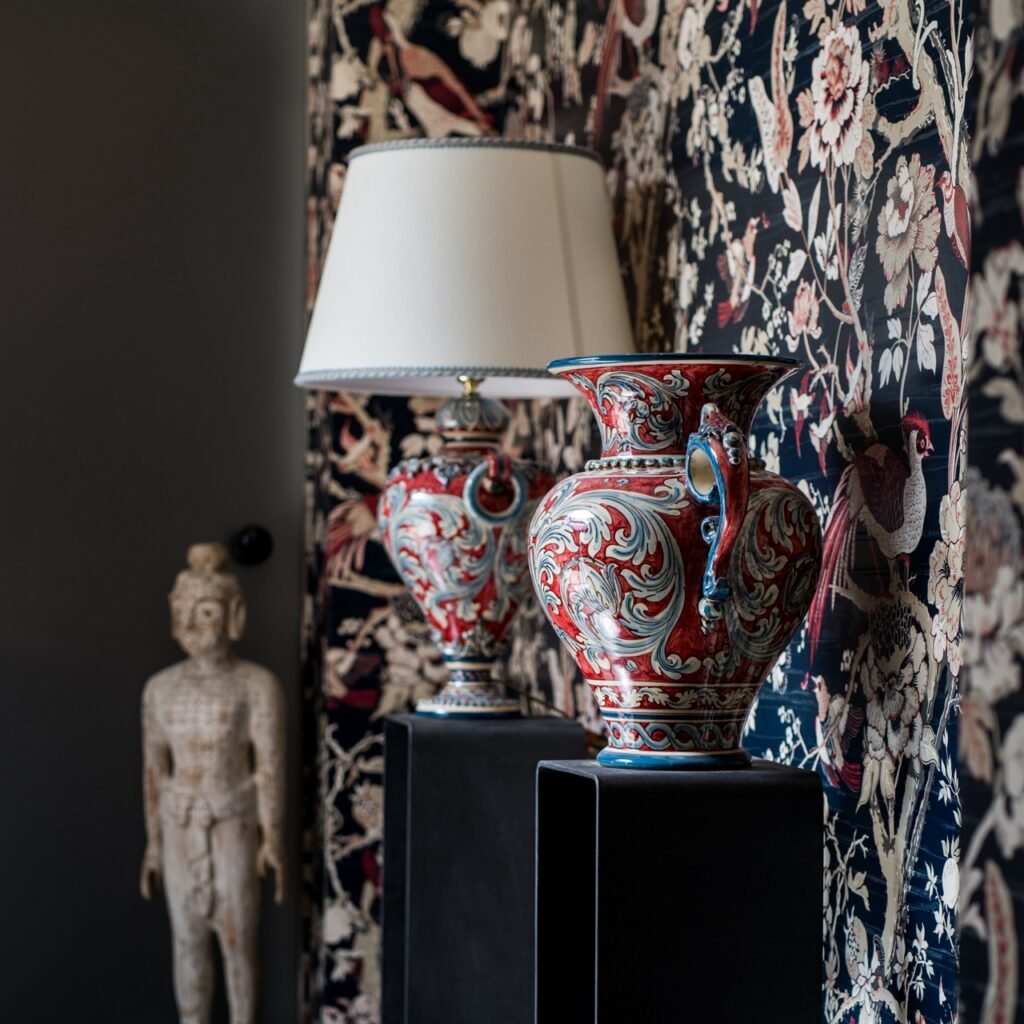
On maiolica the decoration is painted onto raw, unfired glaze, which absorbs pigment on contact like blotting paper. Nothing can be wiped back or gone over, so what the painter did once is what got fired. That leaves traces you can see: a line that thickens where the brush loaded and thins where it lifted, fills that show the direction they were laid in, and outlines that meet their fills closely but not perfectly.
A transfer or a sprayed stencil gives the opposite. Line width stays constant, color sits flat and even, and edges register perfectly against each other. Zoom into a product photograph at full size and look at one curve: if its width never varies, no brush made it. The stages behind this are set out in how Sicilian ceramics are made.
2. Compare two pieces from the same line
This is the check almost nobody makes, and it is the hardest to fake.
Ask for photographs of two pieces of the same model in the same decoration, or find two listings of it. Genuine hand-painted work comes back recognisably the same and measurably not identical: a flower sits a few millimeters over, a border has one repeat more on one than the other, a color runs slightly deeper. Industrial decoration comes back identical, because it is the same printed sheet.
A workshop will send you the photographs without hesitating, and will often tell you the piece you receive will differ slightly from the one pictured. A seller who insists every piece is exactly as shown is telling you something useful.
3. Check the marks, and read what they actually say
Caltagirone workshops sign their work on the base, usually with the workshop name or initials, often the town, sometimes the decoration line or the painter’s mark. Hand-applied marks are painted under the glaze, so they sit beneath a glassy surface and cannot be scratched off.
Two things to be careful about. A printed or stuck-on label on the base means nothing, because it can be applied to anything. And wording is chosen carefully: “Sicilian style”, “Italian design”, “in the Caltagirone tradition” and “decorated in Italy” are all compatible with a body made elsewhere. What you are looking for is a named workshop and a town, not an adjective.
If the base is not photographed at all on a listing, ask for it. It is a normal request and the answer is quick.
4. Read the glaze for the marks of a real firing
A twice-fired tin glaze is not flawless, and its imperfections are the honest kind.

Expect a slightly uneven depth where the glaze pooled and ran before it set, most visible in a recess or at the foot. Expect very small dark specks in the white, from iron in the clay body. Expect the unglazed foot ring or base rim to show the fired clay itself, buff to pale terracotta, faintly gritty to the touch. On relief work, expect the glaze to be thinner on the high points and to have gathered in the hollows, which is what makes the modelling read.
Uniform gloss everywhere, a base glazed as smoothly as the front, and a perfectly even white all point to industrial production. A piece that looks machine-finished usually was. If you are also wondering whether what you are looking at is porcelain, majolica or porcelain settles that with a lamp and a fingertip.
5. Check the weight against the size, and the size against the listing
Earthenware thrown by hand is not thin. A piece has real mass for its size, sits solidly, and has walls thick enough to feel through the rim. Suspiciously light for its dimensions usually means slip-cast thin ware or a different body altogether.
Dimensions are worth a second look for a different reason. Clay contracts appreciably between wet and twice-fired, so two pieces made to the same drawing can finish a centimeter apart, and honest listings give sizes as close rather than exact. A seller quoting one precise figure for every unit of a handmade model is quoting a catalog number, not a measurement.
The other thing people get wrong here is scale in the other direction: Sicilian pieces are consistently larger than photographs suggest. Check the figure in inches as well as centimeters before you decide where a piece is going to stand.
And a word about price
Price is not a proof of authenticity, and expensive imitations exist. But it does set a floor, because the labor in a hand-made piece cannot be compressed.
Count what has gone into a large hand-painted vase: clay refined and aged, the form thrown and joined, weeks of drying, a first firing over more than a day, glazing, a decoration painted in one sitting by someone who has done it for years, a second firing, and the pieces from the same batch that cracked and were lost. That is days of skilled work per surviving object, and no workshop can sell below it for long.
So when a large piece is offered at a fraction of what comparable work costs elsewhere, the arithmetic is the tell. Either it was not made the way the listing implies, or it is not the size the listing implies. Both are worth a question before ordering.
What none of these checks will tell you
They tell you whether an object was made and decorated by hand. They do not tell you who you are buying from, and that is a separate question with separate consequences: lead times, whether the piece is made after you order, who carries the risk in transit, and what happens if it arrives cracked.
The same photograph often appears on a workshop site and on resale listings at very different prices. Our guide on where to buy authentic Sicilian ceramics online goes through the three kinds of seller you will run into and the five things to check before you order. You can also read what our own customers have written.
If you are still working out what the pieces are called, the Caltagirone ceramics buyer’s guide lists the families of pieces and the names of the recurring decoration lines. And if you are ordering from abroad, shipping Sicilian ceramics to the United States covers production times, customs duties and insurance. And once a piece is in the house, how to care for Sicilian ceramics covers washing, frost and what should never go in a dishwasher.