
Ceramiche Sofia: A Workshop in Caltagirone
Ceramiche Sofia is a ceramics workshop in Caltagirone, in the province of Catania, inland from the Ionian coast. The business has two addresses, and the difference between them is worth knowing before you write to us. The clay, the wheels, the glaze tubs and the kilns are at Via Balchino. The finished pieces sit on shelves at Corso Principe Amedeo di Savoia, in the center of town. We have worked here since 2002.
The workshop and the shop are not the same place
The workshop is at Via Balchino 16bis, 95041 Caltagirone (CT), open Monday to Friday, 8.30am to 6.30pm. It is a working space. What is in it on any given day depends on what is drying, what has come out of the first firing and what is waiting for a brush.
The shop is at Corso Principe Amedeo di Savoia 13, 95041 Caltagirone (CT), open every day of the week, 10am to 7.30pm. That is the address to use if you want to pick a piece up, hold it against the light and turn it over. The telephone number for both is +39 0933 335277. Visitors are welcome at the shop during opening hours, and the workshop can be visited by appointment: call ahead and we will tell you what is on the benches that week.
How a piece is made here
We use local clay, thrown on the wheel or pressed in a mold depending on the shape. The piece is dried, then fired once. After that first firing it is dipped in raw glaze, and the painting is done on that unfired surface, which takes pigment the way blotting paper takes ink. A brushstroke cannot be lifted or gone over. The second firing melts glaze and color together into one skin.
Counted properly that is eight or nine stages, and several weeks from the first handful of clay to a piece that can leave the workshop. Most of that time is spent waiting. Drying cannot be hurried without cracks appearing in the kiln, and a kiln cannot be opened early without risking the load. We describe the full sequence, with what can go wrong at each point, in our account of how Sicilian ceramics are made.
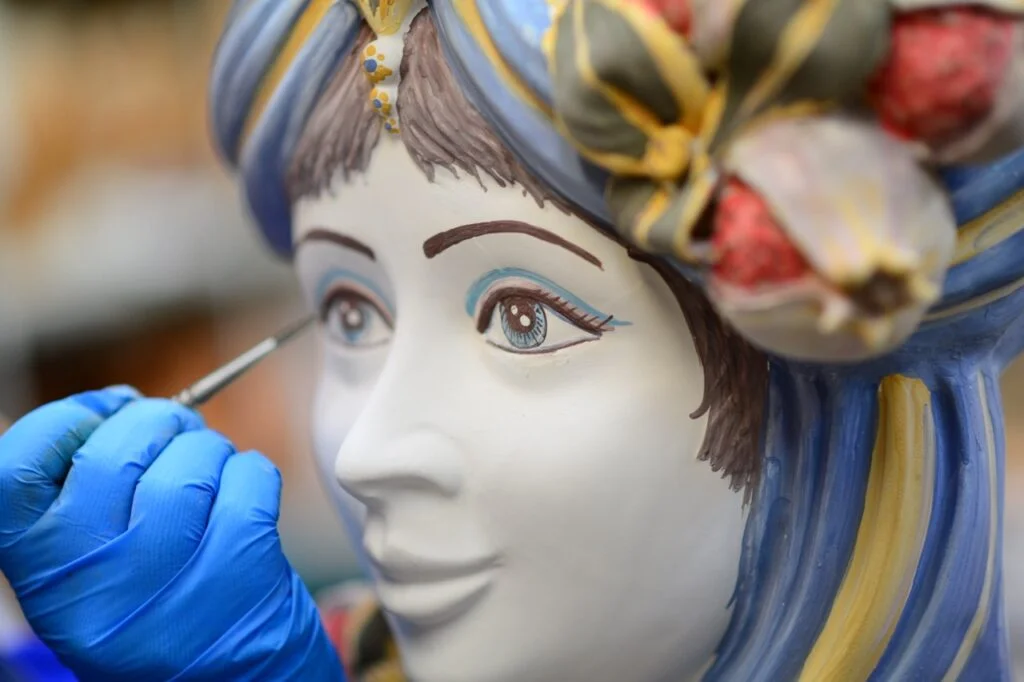
The painting is the part that cannot be handed to a machine. It is done by our maestri decoratori, the master decorators of the workshop, and it is the stage that separates two pieces of the same shape more than any other.
What we make
Everything we sell is made in our own workshop. We do not buy in finished pieces to resell, and we keep to a short list of forms rather than a wide catalog:
- Teste di moro, the painted heads, traditionally a pair.
- Pigne, the pinecones that stand on gateposts, balconies and tables across the island.
- Vasi, vases, the form that shows a painter’s hand most clearly, because the surface curves in two directions at once.
- Lumi, ceramic lamps.
- Acquasantiere, holy water fonts, a small domestic object with a long history in Sicilian houses.
Pieces are made to order as well as sold from the shelf, and we ship worldwide. We will not quote a price or a delivery date, because both depend on the piece, its size and where it is going. If you are buying from outside Italy, our guides on where to buy authentic Sicilian ceramics online and shipping Sicilian ceramics to the USA cover the questions we are asked most.
What hand-painted means, and what it does not
Two pieces from the same pattern will not match. A leaf sits a few millimeters higher. An outline runs thin where the brush dried out, and a blue can read deeper on one side because the glaze went on thicker there. That variation is what hand-painting is, and it is also the thing that occasionally disappoints a buyer who expected the photograph. Better to say so here than after the box is opened.
The same applies to marks. Many Caltagirone workshops sign the base. Ours is signed in the fire: the mark goes on before the final firing, so it sets into the glaze and becomes part of the piece. A printed label can be peeled off and an ink stamp can be washed away, but a fired signature cannot be added to a piece afterwards, and that is the point of putting it there. An unmarked base is still a question rather than a verdict, though: older work often left the workshop unsigned. If you are learning to read a piece, our five checks for identifying authentic Sicilian ceramics are the place to start, and the difference between maiolica and porcelain answers a question that comes up constantly.
Once a piece is on your table the rules are simpler than people fear, though a dishwasher and a hand-painted rim rarely stay friends. We set out what we do and do not recommend in our guide to caring for Sicilian ceramics.
Why this site exists
Ceramiche Siciliane is where we write down what we would tell you across the counter. Most of the questions are the same: is this hand-painted, why does that plate cost three times the other one, will it survive a dishwasher, will it survive a flight. The guides under History & Craft deal with where the work comes from and how it is made, starting with a walk through the island’s ceramic history. The ones under Buying & Collecting deal with choosing, paying and looking after what you bought. If you want one page before the others, take the Caltagirone ceramics buyer’s guide.
Come and see, or write
The shop is open seven days a week. The workshop keeps working hours, Monday to Friday. Call +39 0933 335277 if you want to know what is in the kiln that week, or follow the work on Instagram and Facebook at @sofiaceramiche, and on Pinterest. If a piece is being made for you, ask for photographs before it is packed: they settle more questions than any description.