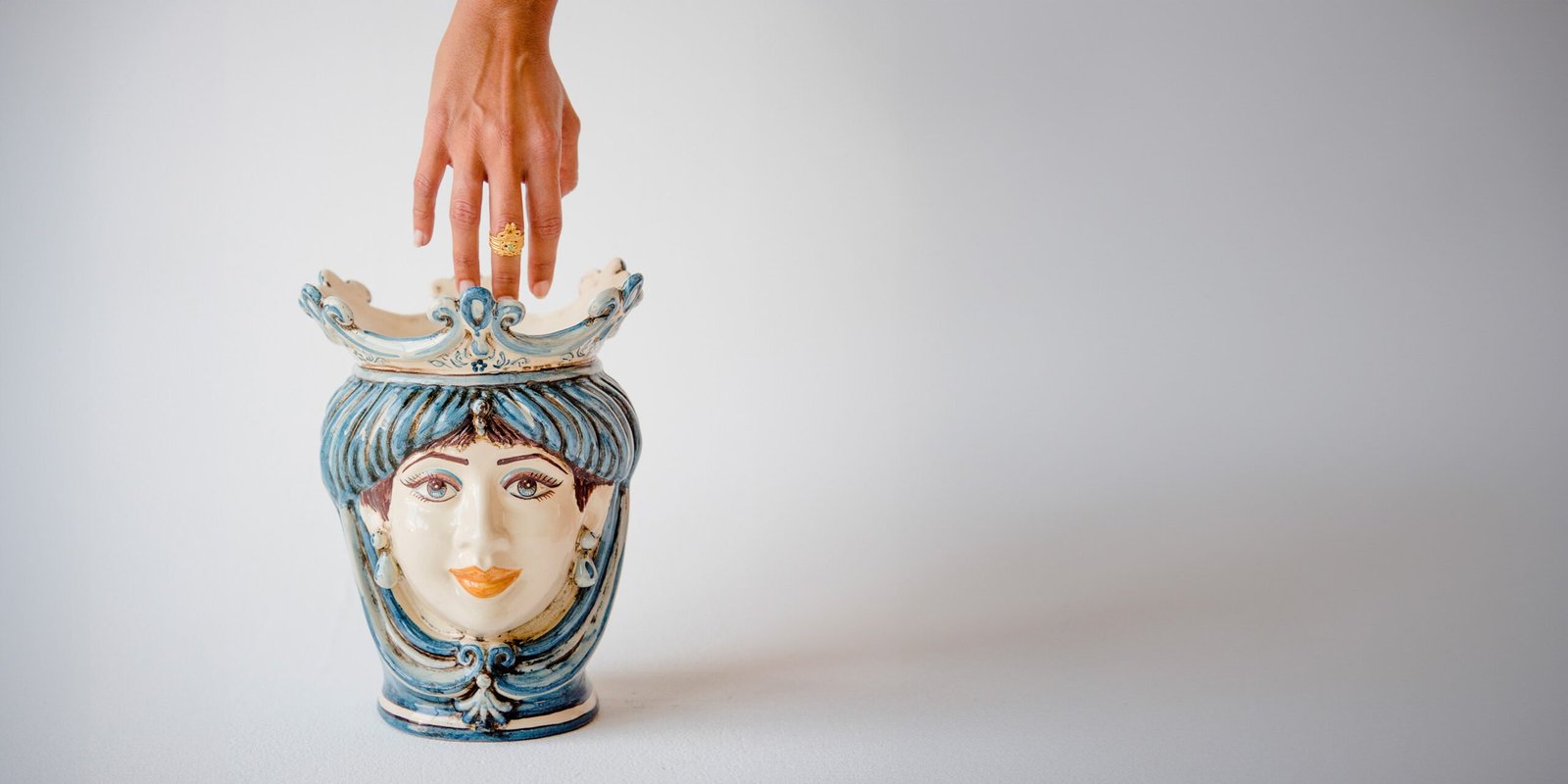
A real pair of Sicilian ceramic heads is two hand-modeled, hand-painted maiolica pieces, fired twice in the same workshop, from the same batch, and sold together as a couple. In Sicily they are called teste di moro, and the honest ones come from a workshop that can tell you where the clay was pressed, who painted the faces, and what the base looks like. Most of what turns up in a search for the phrase does not pass those three questions, so this is the order in which we would check.
What “Real” Means When We Say It
We have made teste di moro in Caltagirone since 2002, and we use the word “real” in a narrow sense. It does not mean old or expensive. It means the pair was formed in Sicily by hand in plaster molds, painted by a person on raw glaze, bisque fired at about 1000 °C (1830 °F), glaze fired at 920 to 980 °C, and made as a set. Everything else in this guide is a way of testing those claims from a distance.
The story behind the shape, the Palermo legend of the girl, the Moor, and the basil, is told in our piece on what a testa di moro is and where the legend comes from. Here we stay on the object: what to measure, what to look at, and what to ask.
If you have not yet chosen the head itself, where it will stand, how much room it has, which finish, that decision comes first, and we walk through it in four questions for buying your first testa di moro. This guide starts after that choice: you know what you want, and you want to be sure it is real.
Start With the Numbers, Not the Photos
Product photos flatter every head the same way. Numbers do not. Before you look at the painting, get three of them from the seller.
- Height. Heads run from about 15 cm (6 in) to well past 60 cm (24 in). The 25 to 30 cm pair, 10 to 12 inches, is what most people picture, and it needs a surface at least as deep as the head is wide, crown and fruit included. Anything over 40 cm is floor or console furniture.
- Opening. The hole in the crown is smaller than the head suggests. On a 25 cm head it is often 8 to 10 cm across, enough for a nursery pot of basil or a small succulent. If you plan to plant, ask whether there is a drainage hole. Many heads are made as ornaments and have none.
- Weight. A single 30 cm head in maiolica weighs on the order of 3 to 4 kg (7 to 9 lb) empty, so a pair is 6 to 8 kg before packing. A listing that gives a weight far below that for the size is describing thin slip casting or something that is not ceramic at all.
That last point matters more than it used to. Resin and plaster copies of Sicilian ceramic heads are common now. They are light, slightly warm to the touch rather than cold, and they give a dull knock when tapped where fired clay gives a clear ring. You cannot tap a photograph, but you can ask for the weight.
A Matched Pair Comes Out of the Same Kiln
In our workshop the man and the woman are pressed from the same mold family, dried on the same shelf, bisque fired in the same load, painted by the same hand within a few days of each other, and glaze fired together. That is what makes them read as a couple rather than as two heads standing near each other.
Hand work leaves differences, and you should expect them. A centimeter of height between the two is normal, because shrinkage from wet clay to finished piece is around ten to twelve percent and never exactly equal across two pieces. Ours differ from each other on purpose, and if two heads match down to the last leaf, a person did not paint them.
Some differences are not normal. They tell you the pair was assembled from stock rather than made together:
- The white ground is a different tone on each head. Tin glaze from one batch has one white, and a head from another batch reads bluer or creamier next to it.
- One head is glossy and the other satin. Same glaze and same firing give the same surface.
- The palettes disagree: a cobalt that is inky on one head and washed out on the other.
- The base marks differ in signature, date, or handwriting.
If you want a true pair, buy both at once. A second head painted a year later, even by us, will be a cousin rather than a twin.
Hand-Painted, Transfer, or Painted After Firing
This is the check most buyers of Sicilian ceramic heads skip, and it is the one that separates the price categories. There are three ways the color can have gotten onto a head.
Painted on raw glaze and fired
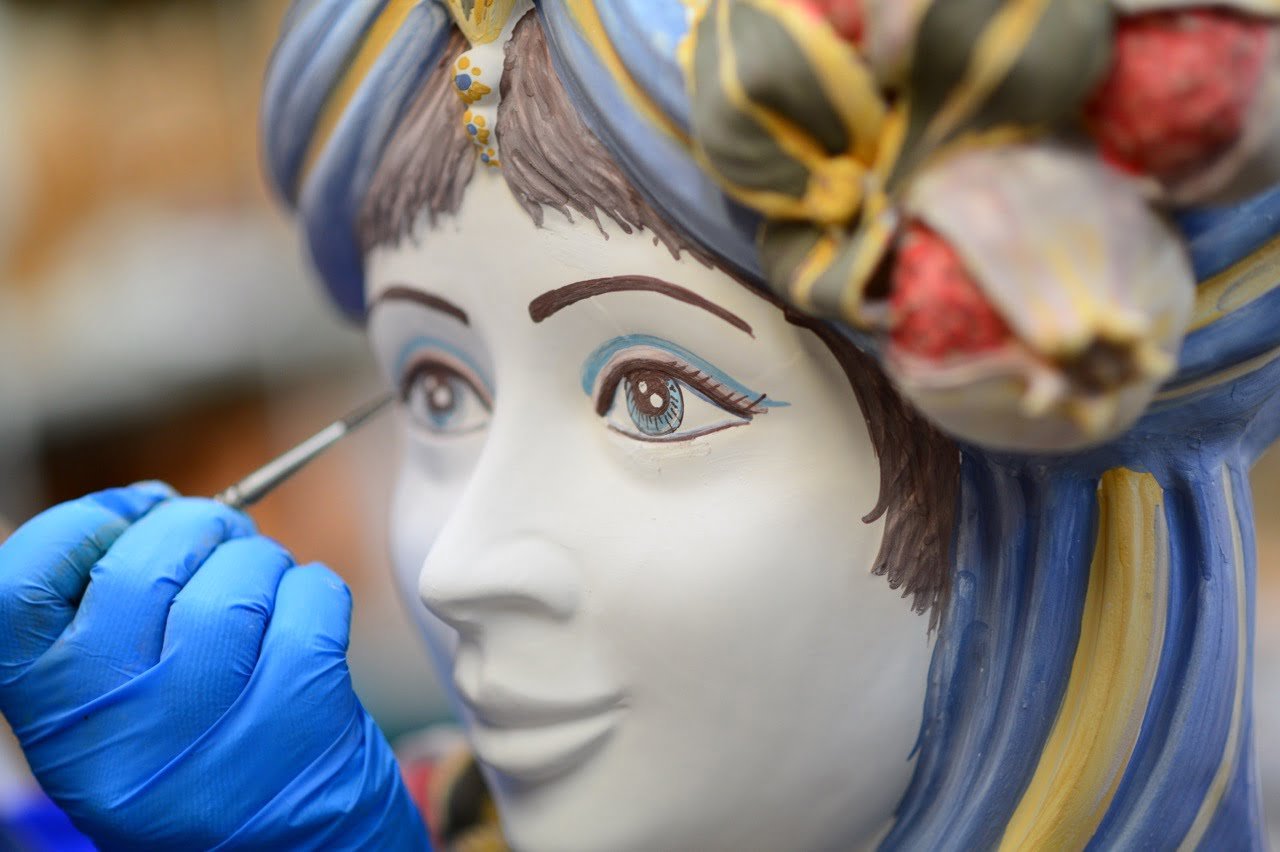
This is maiolica. The bisque head is dipped in tin-white glaze and the painter works on the dry, chalky powder. The stroke fixes the moment it lands, so there is no correcting. Under a loupe the edge of a brushstroke is soft and slightly uneven, thicker where the brush landed and thinner where it lifted. The surface is smooth to the finger, color and white alike.
Transfer or decal
A printed design is applied to an already glazed head and fixed with a low third firing. Two things give it away. Every repeat of a motif is identical, so compare the same lemon on both heads, and the same eye. And under magnification the color often breaks into a regular dot pattern, the way a magazine picture does. Decals also tend to stay on the flatter areas and avoid the deep folds of the crown and fruit.
Painted after firing
Acrylic or enamel applied on top of a fired glaze, sometimes over a plain white head, sometimes over resin. This is the version that fades outdoors. Scratched gently with a fingernail on an inside edge, it lifts. Fired maiolica does not scratch off, and its colors do not fade, because they sit inside glass that melted above 900 °C.
Ask the seller which of the three it is. A workshop answers without thinking. A reseller who does not know is telling you something too.
Turn It Over: The Base and the Inside
Ask for a photo of the base and, if you can get it, of the inside. It is the least flattering angle and the most informative one.
On a head that went through a real glaze firing, the foot ring is unglazed or wiped clean, because glaze would fuse the piece to the kiln shelf. You may see three small stilt marks where the piece was propped. The bare clay shows the body color. Ours fires to a pale buff with a pink cast. Other Sicilian workshops use whiter bodies, so treat color as a clue rather than a verdict. There is normally a mark: a workshop name, a painter’s initials, the word Caltagirone, sometimes a year. A fully glazed, spotless base with only a printed label is a reason to ask more.
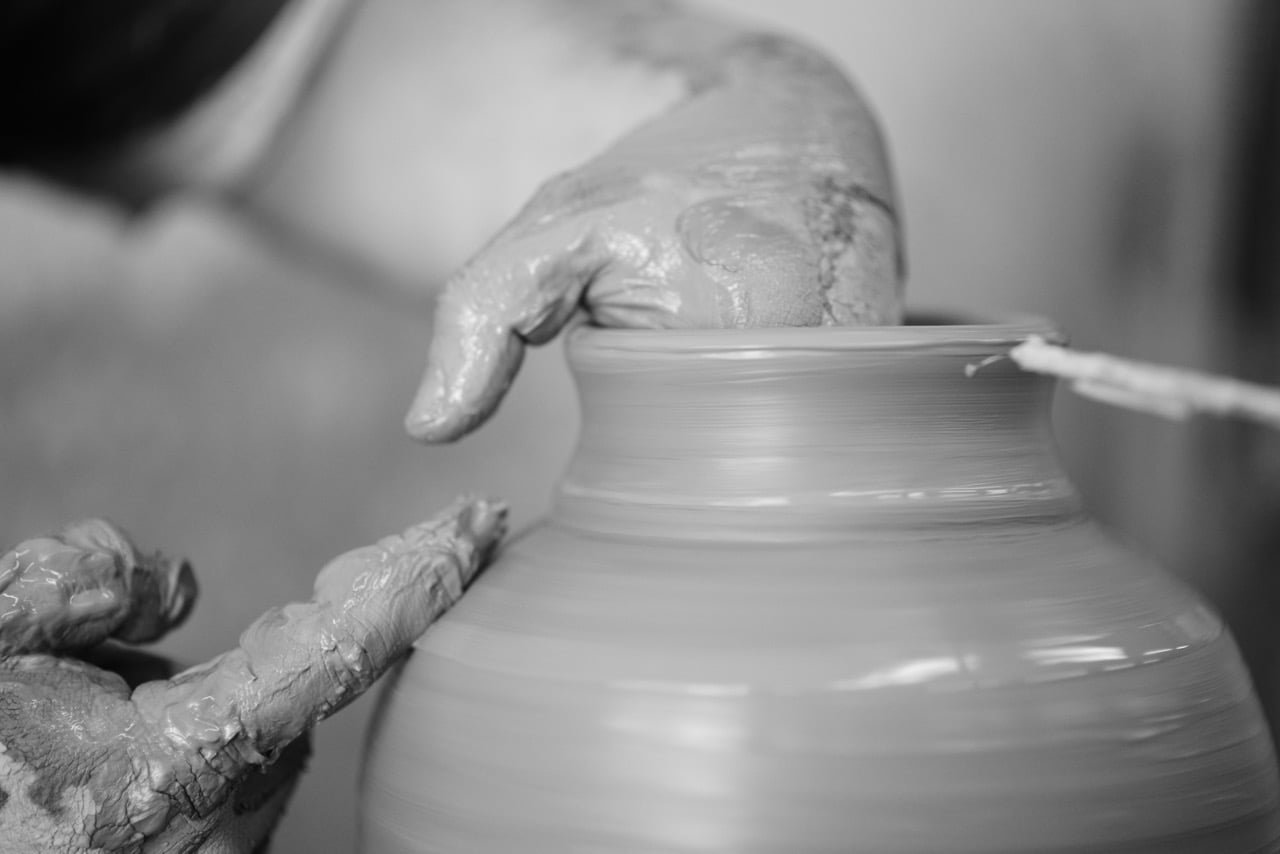
Inside, expect a rougher surface than outside. The join of the two mold halves is worked from the inside as far as a hand can reach and then left alone. A perfectly smooth, thin, uniform interior usually means slip casting, where liquid clay is poured into a mold and drained. Slip-cast heads are still ceramic, but they are not the pressed, modeled object a Caltagirone price pays for.
Flaws That Are Normal and Flaws That Are Not
Handmade, twice-fired ceramic is not flawless, and a seller who claims otherwise is retouching photos. These are consistent with a genuine piece:
- Pinholes in the glaze and a few dark specks where iron in the clay burned through.
- A faint seam behind the ears where the mold halves met.
- Fine crazing in the glaze, cosmetic rather than structural.
- Small differences between the two heads in size, expression, and where the fruit sits.
These are not normal, and you should ask before paying or refuse on arrival:
- A hairline crack through the body, visible inside and out. It usually means thermal shock from a kiln opened too soon, and it will grow.
- Glaze that has crawled away in patches, leaving bare bisque.
- Chips or glued repairs on the crown points or the nose. A repair shows as a slightly different white with a fine line around it. Fired joins have no glue line.
What you are buying is a specific pair, not a design. Ask for photos of the exact two heads you will receive, in daylight, base included.
The Questions a Workshop Can Answer in One Email
Everything above can be settled with a short message to the seller. We answer these every week, so we know how a real workshop responds.
- Where were the heads formed, and where were they painted? Two different places is a legitimate answer, but it should be a straight one.
- Who painted this pair? A name, not “our artisans.”
- Are the two heads from the same batch and the same painter?
- Painted on raw glaze, decal, or painted after firing?
- Height, crown opening, weight, and whether the base is drilled.
- Photos of the exact pair, including the base and the inside.
- How is it packed, and what happens if a piece arrives broken? Any seller of heavy ceramic should have a clear answer.
A workshop that fires its own kilns will answer all seven in a paragraph. Hesitation, stock photos, or “handmade in Italy” with no town attached usually mean you are talking to a reseller who has never held the piece. Our guide on where to buy authentic Sicilian ceramics online goes into how to read a listing or a workshop site with this in mind.
Frequently Asked Questions
Is a signature on the base proof that the heads are from Caltagirone?
No. A signature is a claim, and anyone can write Caltagirone in cobalt. It becomes evidence when it names a workshop you can find and contact, and when it agrees with everything else: an unglazed foot ring, a pressed interior, brushwork that differs between the two heads, and a seller who can name the painter.
How much should a real pair of Sicilian ceramic heads cost?
We will not put a number here, because price moves with size, the density of the painting, and gold or luster, which needs a third firing. In our workshop a 30 cm pair takes three to six weeks from wet clay to shelf, including drying and two firings, plus a painter’s time on two faces. A pair priced like a mass-market vase has not had that work put into it.
Do I have to buy a man and a woman?
The traditional pair is a couple, the Moor and the girl from the legend. But workshops, ours included, make two women, single heads, and heads in one color, and none of that makes a piece less genuine. What makes it real is how and where it was made, not the pairing.
Can I judge a pair well enough from photos?
Mostly, yes, if you ask for the right photos: the exact pair rather than a catalog image, in daylight, the base, the inside, and one shot with a ruler for scale. Add the weight and the seven questions above and you will know more than most people who buy in person.