The lemon you see on Italian ceramics is a young motif. Most of what circulates today traces back to the Amalfi Coast, and to Vietri sul Mare in particular, where painters settled on it during the twentieth century. It is not part of the old maiolica repertoire of Sicily, Deruta, or Faenza. The fruit itself has been Sicilian for around a thousand years, which is why we paint it in Caltagirone with a different hand than a Vietri workshop would.
The fruit came to Sicily a thousand years before the pattern
Citrus reached Sicily with Arab growers, most likely in the tenth century: the citron and the bitter orange first, the lemon shortly after. By the 1800s the island was shipping lemons to Britain and the United States in serious volume, and Sicilian nurserymen were selecting their own varieties. The Femminello Siracusano still carries the Syracuse groves; the Interdonato, developed in the Messina area in the nineteenth century, is picked early with the peel still faintly green.
None of that put a lemon on a plate. Sicilian maiolica from the sixteenth to the eighteenth century runs on something else entirely: geometric borders, grotesques, saints and soldiers, coats of arms, painted in cobalt blue, antimony yellow, copper green and manganese brown on a tin-white ground. If you want the long version of that history, we set it out in our introduction to Sicilian ceramics and its history. Lemons are simply not in it.
Where the painted lemon actually comes from
Vietri sul Mare, on the Campanian coast south of Naples, is the honest answer. Between the late 1920s and the war, a group of German-speaking artists worked in the Vietri factories and pushed the local painting toward flatter shapes, heavier outlines, and a poster-like simplicity. Coastal subjects took over as the house language: donkeys, fishermen, the terraced groves, the fruit itself. Postwar tourism on the Amalfi Coast did the rest.
We cannot tell you who painted the first lemon plate, or in what year. The documentation for that question is thin, workshops copied each other freely up and down the coast, and nobody signed and dated a test piece for the benefit of historians. What is clear is the direction of movement: the motif spread outward from Campania and reached Sicily as buyer demand, in the second half of the twentieth century, long after our own repertoire had been fixed.
A Sicilian lemon and an Amalfi lemon are not the same lemon
The Amalfi lemon, the sfusato, is long and tapered, pale, with thick white pith. The Sicilian femminello is rounder, deeper in color, with a small nipple at the tip. Our painters draw what they see out the window, so a lemon from this workshop tends to come out shorter and fuller than one painted in Vietri, and we usually hang it on a branch with the blossom, the zagara, five white petals, somewhere in the composition.
The setting differs too. A Vietri piece often floats the fruit on a broad white field with a loose blue wash for sky or sea. We tend to close the plate with a border from the local vocabulary: a green geometric band, a running leaf, sometimes the scale pattern borrowed from the pigna. Neither approach is more correct. It just tells you whose hand held the brush.
How we paint and fire one
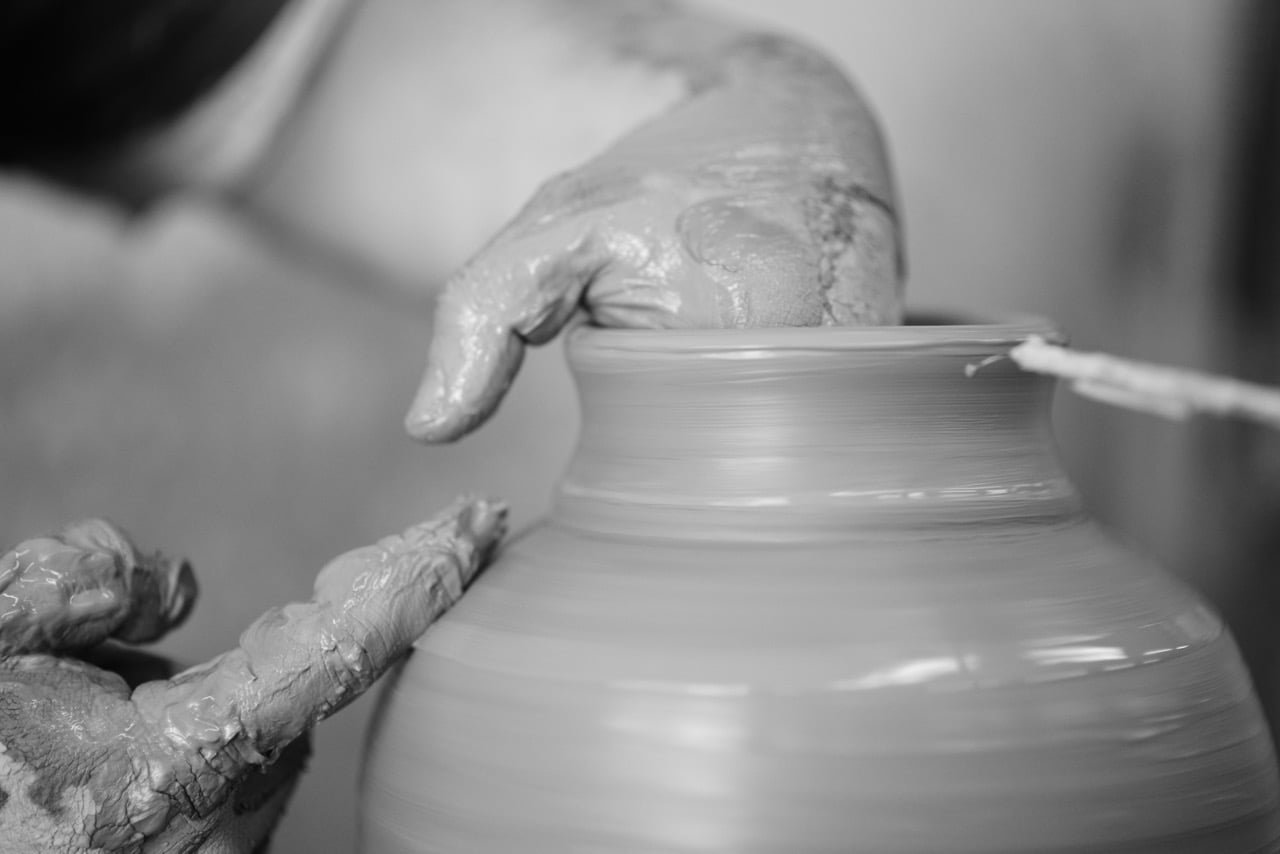
The body is local earthenware, thrown or press-molded, then dried for five to ten days depending on thickness and the season. A piece shrinks about 10 to 12 percent between wet clay and finished ware, so a 30 cm (12 in) serving bowl starts out closer to 34 cm on the wheel.
We fire twice. The first firing, the biscuit, goes to roughly 1000°C (about 1830°F): around nine hours climbing, then a full day cooling before we open the kiln. The biscuit is dipped in an opacified white glaze, historically tin and today more often zirconium, which dries to a chalky layer less than a millimeter thick.
The painting happens on that raw, unfired glaze, and this is the part buyers rarely picture. The surface drinks the pigment the instant the brush touches it. There is no erasing and no going back over a line to correct it; a bad stroke means washing the glaze off the piece and starting again. For repeated patterns our painters still use spolvero: a paper cartoon pricked along the drawing, laid on the glaze and dusted with charcoal so a faint dotted outline transfers through. Smaller work is drawn freehand. The outline goes down in manganese or cobalt with a long fine brush, then the yellow, then the green. Historic yellow came from lead antimonate; ours is a lead-free praseodymium-zirconium stain, which holds its tone through the fire instead of drifting orange.
The second firing, between 920 and 980°C (roughly 1690 to 1800°F), melts the glaze and pulls the color down into it. That is why a properly made piece cannot be scratched off with a fingernail: the decoration sits in the glaze, not on top of it. Gold, when a piece calls for it, needs a third pass at about 720°C. Every load loses a small percentage to crawled glaze or cracks. Those go in the yard, not in the catalog.
Telling hand-painted from printed
Turn the piece over first. Most workshops leave the foot ring unglazed so you can see the clay body, and most of us sign or mark the base. Then look at the lemon in raking light.
- Hand-painted color varies in density across a single fill, and the pigment pools slightly where the brush lifted.
- The outline wanders by a fraction of a millimeter. A printed one does not.
- Under a cheap loupe, a decal shows a regular dot pattern, often in rosettes, and edges that are equally crisp everywhere. Sometimes you can feel a faint film edge with a fingertip.
- Two plates of the same pattern will never match exactly. Leaves sit at different angles; one lemon is a touch fatter than the other.
Some workshops print the outline and fill the color by hand. That is a legitimate way to work as long as it is disclosed, so ask, and expect a straight answer.
What counts as a flaw and what does not
Fine crazing in the glaze, small dark specks from iron in the clay, a pinhole or two, a slight wobble in a hand-thrown foot: these come with earthenware and hand work. Sharp glaze chips, a crack that catches a fingernail, a lemon painted off-center on a plate meant to be symmetrical: those are seconds and should be sold as seconds.
On use, be direct with the seller. Ask whether the piece is tested for food contact under the EU ceramics rules or the FDA limits for lead and cadmium release, because decorative ware is not always certified for it. Earthenware stays porous under the glaze and dislikes thermal shock, so hand washing is safer, and nothing should go straight from refrigerator to oven. Anything with gold stays out of the microwave.
Which shapes carry the motif
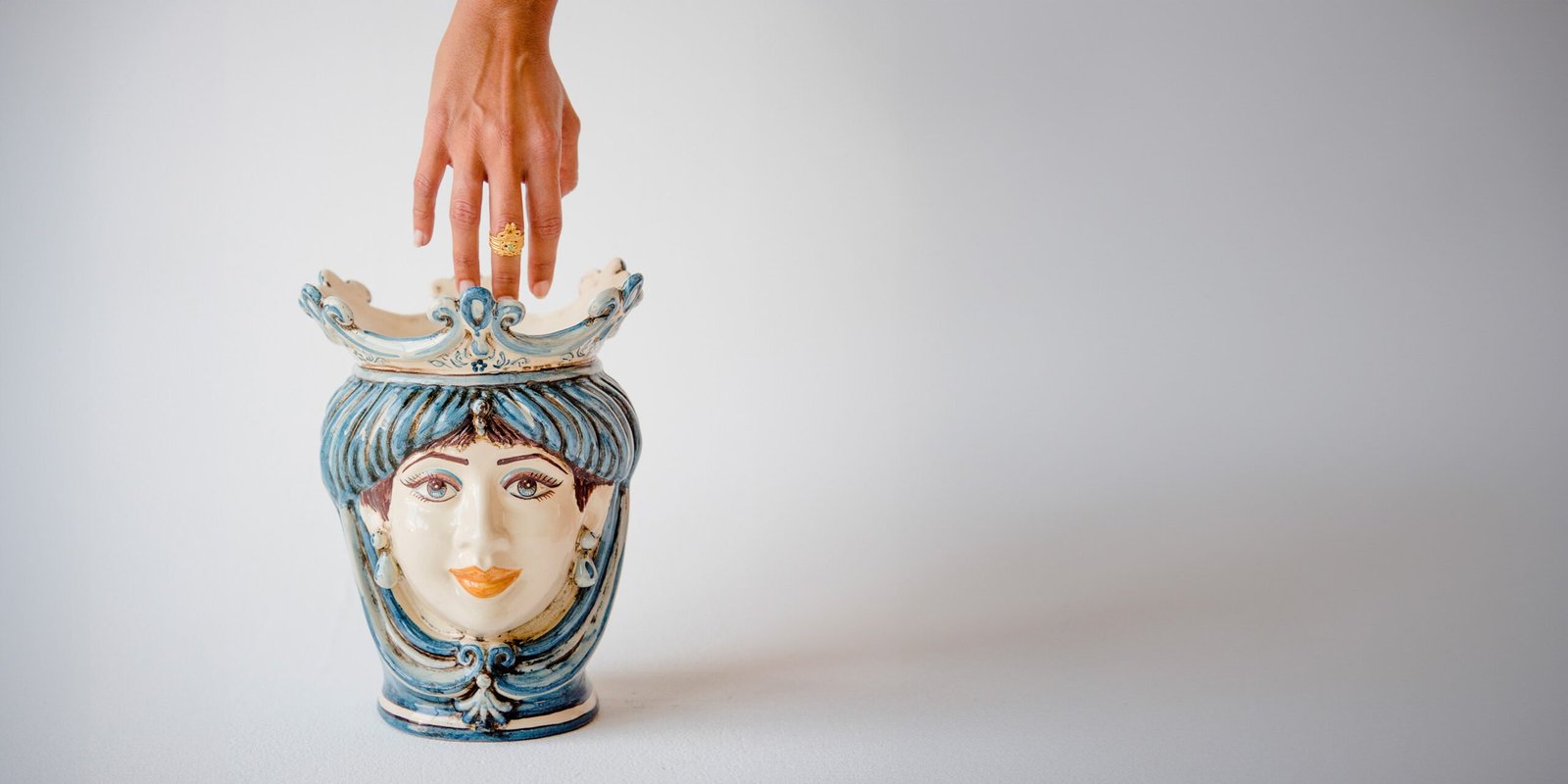
A single lemon with two leaves reads better on a 27 cm (10.5 in) dinner plate than a crowded branch; the branch belongs on larger surfaces. Pasta bowls at 22 to 24 cm, serving bowls at 30 to 35 cm, a pitcher of roughly 1.2 liters, oil cruets, and 20×20 cm wall tiles all take the pattern well. So does a testa di moro, which in Sicily is more often planted with a real lemon tree than painted with the fruit.
One piece of practical advice: twelve identical lemon plates on one table get loud. Mixing the lemon service with plain green or white side plates from the same workshop, fired in the same glaze, usually looks better and lets you build the set over time.
Questions we get
Are lemon-painted ceramics actually Sicilian?
The lemon has been a Sicilian crop for roughly a thousand years, but the painted motif is not part of the historic Sicilian repertoire; it took shape on the Amalfi Coast in the twentieth century. Workshops in Caltagirone paint it today, in a Sicilian hand and with Sicilian borders. There is nothing dishonest in that, as long as nobody sells it to you as a Renaissance tradition.
How can I tell hand-painted lemons from a printed decal?
Look for variation: uneven color density inside a fill, an outline that drifts, pigment pooling where the brush lifted. Under a loupe, a decal shows a regular dot pattern and uniformly crisp edges. Then compare two pieces of the same pattern, because hand-painted ones never match exactly.
Can hand-painted lemon plates go in the dishwasher?
We recommend hand washing. The decoration is fired into the glaze at 920 to 980°C and will not wash off, but earthenware stays porous underneath, and repeated hot cycles with harsh detergent dull the surface and encourage crazing over the years. Any piece with gold should never see a dishwasher or a microwave.
If I buy more pieces later, will they match what I already have?
They will be close, not identical. Pigment batches shift, painters change, and a lemon drawn three years from now will not be the same lemon as one drawn today. If you want a set that reads as one set, buy it in a single order.