Vietri sul Mare is on the Amalfi Coast in Campania, roughly 250 miles north of our workshop in Caltagirone, Sicily, and the two towns paint in different dialects. The quickest tell is the drawing: Vietri paints loose and naive with its eye on the sea, while Caltagirone draws tighter, outlines in manganese brown, and leans on Baroque ornament, Moorish heads, and pinecones. Color alone will mislead you, because both towns use cobalt blue, bright yellow, and lemons.
Two towns, two traditions
Vietri has made tin-glazed pottery for centuries, with production documented since at least the 1400s, but the look most people recognize today dates from the 1920s to the 1940s. German and Central European artists such as Richard Dölker and Irene Kowaliska worked in the local factories during those years and pushed the town toward a deliberately simple folk style: little donkeys, fishermen, suns with faces, fish, and lemons painted fast and bright. When someone searches for Italian ceramics from Vietri, that is almost always the style they have in mind.
Caltagirone sits inland, in the hills of the Catania province. Our tradition was shaped by Arab rule between the 9th and 11th centuries, then by the Spanish Baroque, and it shows: scrolling acanthus leaves, trellis patterns, pharmacy jars, and the teste di moro that now travel the world. The town rebuilt after the 1693 earthquake, and in 1954 the 142 risers of the Santa Maria del Monte staircase were faced with majolica tiles, a different pattern on every step.
Technically the two towns are cousins. Both make majolica, which means red earthenware clay covered with an opaque white tin glaze and painted on top of that glaze before the second firing. In our workshop we fire twice: a bisque firing at around 1000°C (about 1,830°F), then a glaze firing at 920 to 980°C (about 1,690 to 1,800°F) after painting. Vietri workshops fire twice as well, so if a seller tells you one town’s pottery is ‘fired harder’ than the other, ask what they mean. We have never seen data to support it.
Start with the subject matter
Subject is the first and most reliable filter. Vietri’s repertoire faces the sea. Expect the ciucciariello, a small stylized donkey carrying baskets; fishermen and boats; a sun with a round face; fish in rows; roosters; lemons and grapes; and wide colored bands called fasce that wrap around plates and bowls. Human and animal figures are flattened and childlike on purpose. That is the style, not a lack of skill.
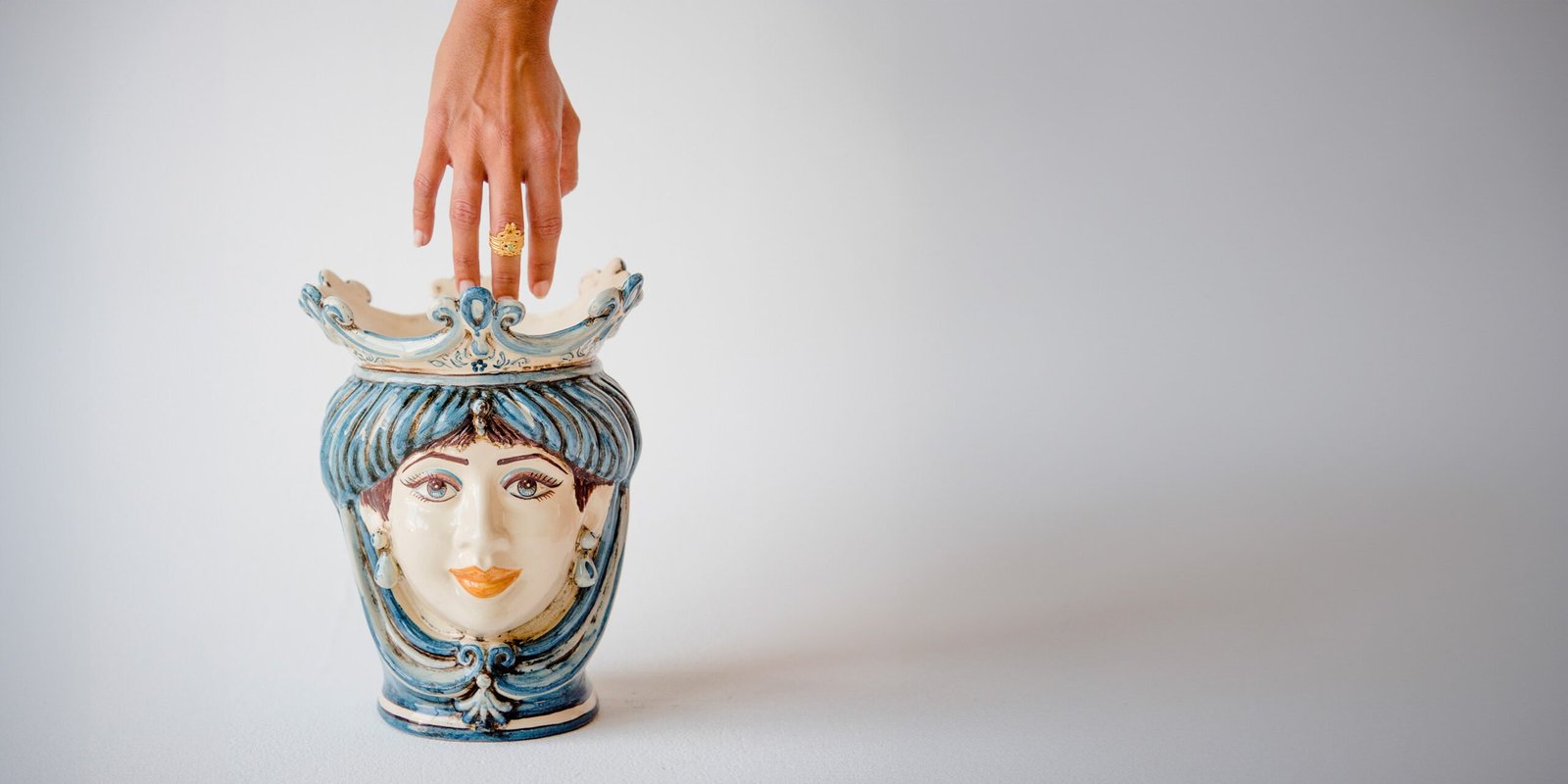
Caltagirone’s repertoire is ornamental and Baroque. Look for the testa di moro, a pair of crowned heads used as planters; the pigna, a pinecone-shaped good-luck piece; the Trinacria, the three-legged symbol of Sicily; prickly pears, oranges, and lemons; birds perched in curling foliage; and the decoro ‘600 and decoro ‘700, which are 17th- and 18th-century pattern families built on acanthus scrolls, lattices, and stylized carnations. Nativity figurines and saints are a Caltagirone specialty too.
The overlap is the lemon. Both coasts grow them and both towns paint them. A lemon on its own tells you nothing about origin. Look at how it is drawn instead.
Look at the brushwork and the outlines
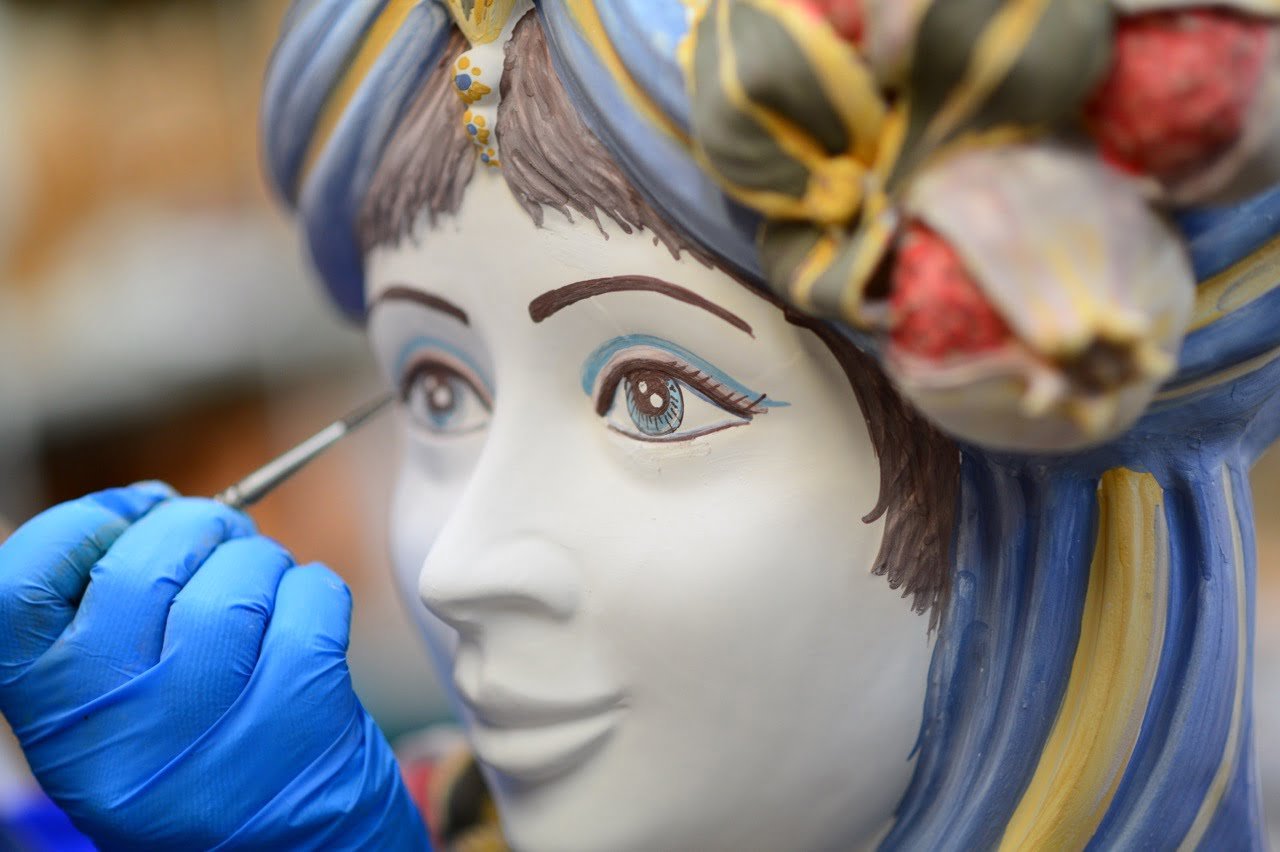
Our painters draw first and fill second. The contour goes down in manganese, a brown that fires almost black, using a fine brush. Then the colors are laid inside the lines. On a finished Caltagirone piece you can usually see the dark outline running under or beside every colored area, and the line is continuous and controlled, the way a pen drawing is.
Vietri painters tend to build the image directly in color. Outlines are often missing, or they are blue rather than brown, and the strokes are broad and quick. A Vietri fish might be three strokes of green, a dot for the eye, and a fast tail. White glaze is left showing between shapes rather than being filled edge to edge.
Two cautions. First, painters move between towns and copy each other, so a modern Vietri workshop may outline and a Caltagirone painter may go loose on a cheap souvenir. Second, hand-painted pieces vary. Our own painters do not produce identical plates, and neither do theirs. Judge the habit across several pieces from the same maker rather than from one photo.
Colors overlap more than you expect
The historic Caltagirone palette has four colors: cobalt blue, copper green, antimony yellow, and manganese brown. Orange and a warm red were added during the 20th century and are now common, especially on teste di moro. Our green is a deep, slightly bluish copper green, and the yellow leans toward ochre on traditional patterns.
Vietri uses cobalt and yellow as well, which is why the two get confused online. The differences are in saturation and application. Vietri yellow is brighter and more lemon-toned, the green is lighter and grassier, and a saturated orange-red shows up on suns and bands. Colors are applied in larger flat fields rather than in small filled cells.
Treat this as a tendency, not a test. Warm shop lighting and phone cameras shift everything. If you are buying online, ask for a photo in daylight next to something white.
Shapes and weight in the hand
Each town has forms the other rarely makes. From Caltagirone: teste di moro, most often 25 to 40 centimeters tall (10 to 16 inches); pigne from a few centimeters up to garden size; lumere and quartare, the traditional oil lamps and water jars; tall albarelli; planters; and nativity figures. Many of these are hand-built or pressed in plaster molds and then finished by hand. They are heavy. A mid-size testa di moro from our workshop weighs 3 to 5 kilograms (7 to 11 pounds), and the walls are thick because a hollow form carrying that much glaze has to survive two firings.
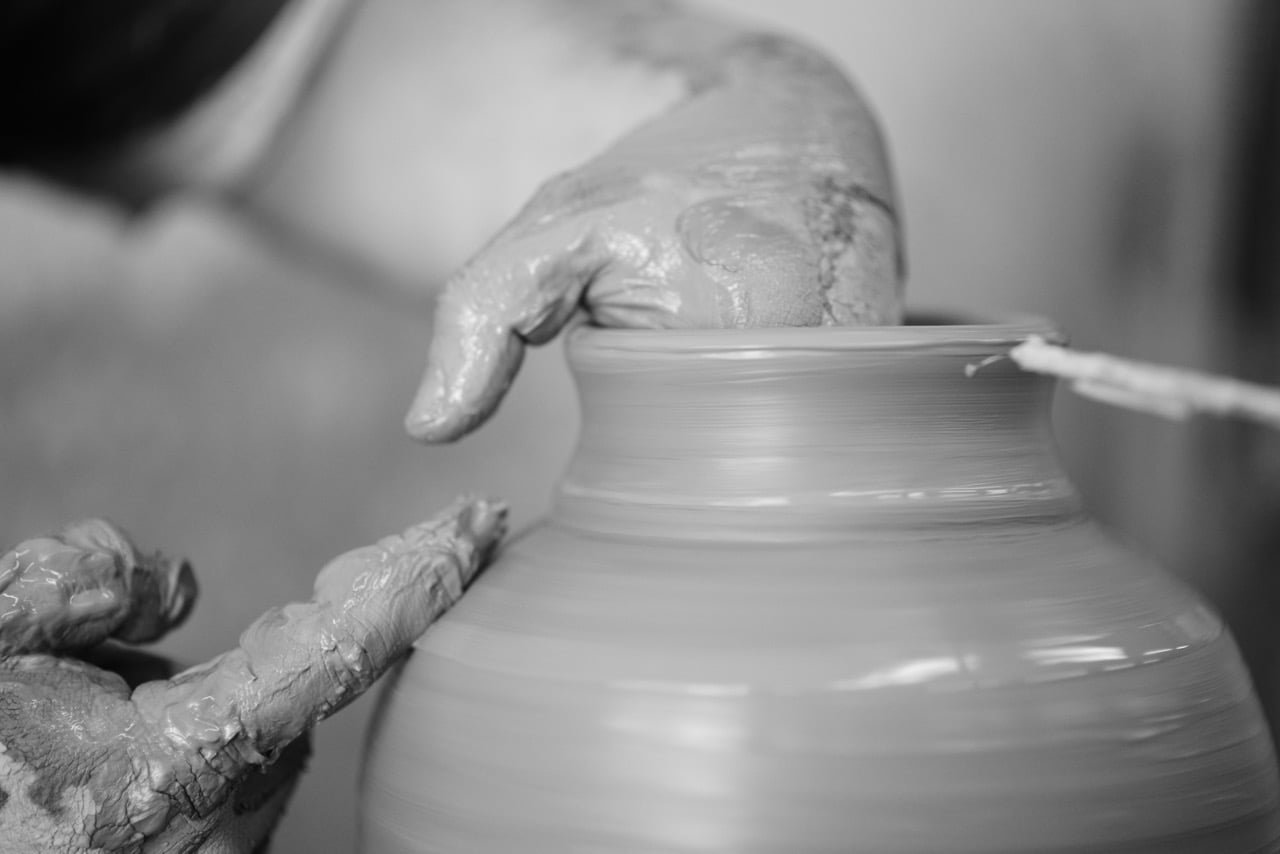
From Vietri: plates and wall plates, bowls, pitchers, espresso cups, tiles, house-number tiles, tabletops, and small donkey figurines. Tiles are the town’s other industry. You will see Vietri tiles on church domes along the Amalfi Coast, and a stack of 20 by 20 centimeter (roughly 8 by 8 inch) painted tiles is more typical of Vietri than of us. Vietri tableware is generally thinner and lighter than a comparable Caltagirone piece, though both towns throw on the wheel and both make plates.
Turn it over
The base tells you more than the front. Most workshops in both towns sign in glaze under the foot: the town name, the workshop or painter, and often the words dipinto a mano, which means hand painted. A Vietri piece usually says Vietri or Vietri sul Mare; ours say Caltagirone. Neither town uses a single official back stamp, so a missing signature is not proof of a fake, and a printed one is not proof of authenticity.
Both towns are also recognized under the Italian system for artistic and traditional ceramics, known as CAT, which allows a certification mark on qualifying pieces. Not every workshop applies it and its absence proves nothing, but its presence is worth something.
Check the unglazed foot ring. Both towns fire reddish earthenware, so clay color alone will not settle the question, but it will rule out white porcelain or stoneware blanks decorated to look like either. Keep in mind that the signature tells you where a piece was decorated. It does not always tell you where the blank was thrown, because buying undecorated blanks is a known practice in more than one Italian ceramics town.
Mistakes we see buyers make
- Lemons mean Amalfi. Sicily grows the same fruit and paints it constantly. Check the outline and the pattern around the lemon, not the lemon itself.
- A Moorish head must be from Caltagirone. The design is now made in Vietri, in Tuscany, and outside Italy, sometimes with printed decals. Look for a manganese outline, thick walls, a signed unglazed base, and slight asymmetry between the two heads.
- Confusing Vietri with Deruta. Deruta, in Umbria, paints Renaissance patterns with very fine lines and mythical creatures. It is neither loose like Vietri nor Baroque like Caltagirone.
- Not checking for decals. A transfer print repeats exactly and shows a dot grid under a magnifying glass. Brushwork does not. We cover this and the other checks we use on our own bench in our five tips for identifying authentic Sicilian ceramics.
- Trusting a listing title. Sicilian and Amalfi are marketing words. Ask for a photo of the base before paying.
Frequently asked questions
Is Vietri pottery Sicilian?
No. Vietri sul Mare is in Campania on the mainland, near Salerno. Caltagirone is in Sicily. Both are Italian majolica towns, but they belong to different regional traditions with different motifs and drawing habits.
Which is better quality, Vietri or Caltagirone?
Neither by default. Both are hand-painted tin-glazed earthenware fired twice, and quality depends on the individual workshop. Compare the crispness of the drawing, the evenness of the glaze, and the finish of the base rather than the town name.
Are teste di moro made in Vietri too?
Yes, some Vietri workshops now make them because demand is high. The form originated in Sicily and the classic version is a Caltagirone piece, but a town name on a listing does not guarantee where a given head was made. Judge it by outline, weight, and base.
Why don’t two pieces from the same workshop match exactly?
Because they are painted by hand, one at a time. Line weight, color density, and small details shift from piece to piece, and the glaze moves a little in the kiln. Perfectly identical pieces are a warning sign of transfer printing, not a mark of quality.