The face at the center of the Sicilian flag is Medusa. Her head, ringed with snakes and sometimes with small wings, sits in the middle of the Trinacria, the three bent legs that stand for the island. The Greeks who settled Sicily carved her on their temples to keep evil away, the Romans struck her on coins, and in 2000 the Sicilian Region put her on its official flag. In Caltagirone, where our workshop is, she has become something else as well: a ceramic head, modeled and painted by hand, that people now keep at home for the same old reason.
This page tells her story in order: who Medusa was, how she reached Sicily, how she ended up on the flag, and what a Sicilian Medusa looks like when it comes out of our kiln.
Who Medusa was
The oldest account is in Hesiod, the Greek poet of the 7th century BC. Medusa was one of three Gorgon sisters, daughters of the sea gods Phorcys and Ceto. Her sisters Stheno and Euryale were immortal. She was the only one who could die.
The version most people know today comes later, from the Roman poet Ovid. In his telling, Medusa was a beautiful young woman. Poseidon assaulted her inside the temple of Athena, and the goddess, angered that her temple had been violated, punished Medusa rather than the god: her hair became snakes, and anyone who met her eyes turned to stone. Later retellings made her a priestess of Athena, which sharpens the injustice of the story and explains why so many modern readers see her as a victim rather than a monster.
The hero Perseus was sent to bring back her head. Hermes gave him winged sandals and Athena a polished shield, so he could watch Medusa in its reflection instead of looking at her directly. He cut off her head while she slept. From her neck sprang Pegasus, the winged horse, and the warrior Chrysaor. Perseus later gave the head to Athena, who set it on her aegis, the protective goatskin she wore across her chest.
That last detail matters for everything that follows. Once the head belonged to Athena, it worked for her. A face that could turn enemies to stone became a guard. The Greeks called this image the gorgoneion, and they painted and carved it on shields, doorways, roof tiles and drinking cups to turn bad luck away from whatever lay behind it.
Medusa in ancient Sicily
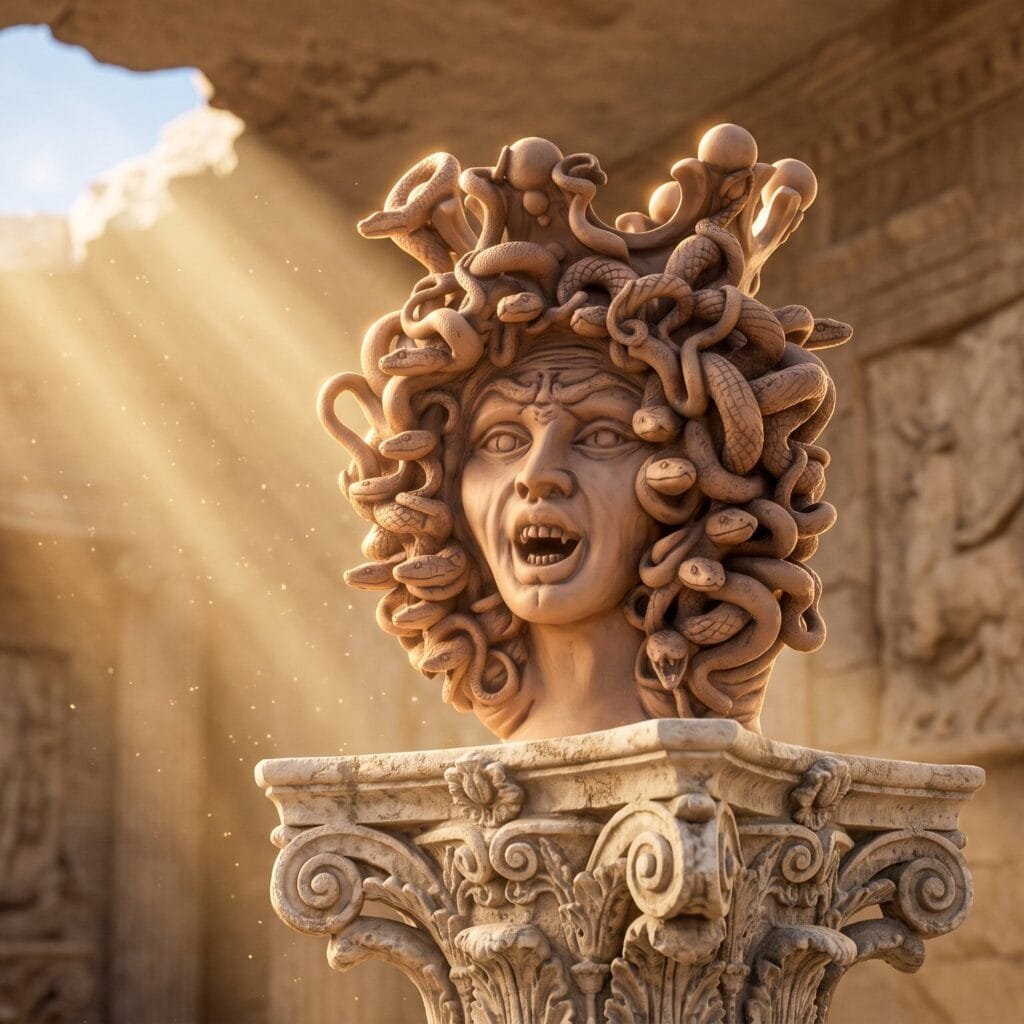
Greek colonists began arriving in Sicily in the 8th century BC, and they brought the gorgoneion with them. The clearest example is at Selinunte, on the southwest coast. On Temple C, built in the 6th century BC, one of the carved stone panels above the columns shows Perseus cutting off Medusa’s head while Athena stands beside him. Pegasus is already in Medusa’s arms. The panel, dated to roughly 540 to 510 BC, is now in the Antonino Salinas archaeological museum in Palermo, and it is one of the best known images of Medusa anywhere in the Greek world.
Medusa in these early images is not beautiful. She is wide-faced, with a grin and a tongue sticking out, meant to frighten. The softer, sadder Medusa of later art came centuries afterward. In Sicily both faces survive: the guardian and the wronged young woman.
How Medusa ended up on the flag of Sicily
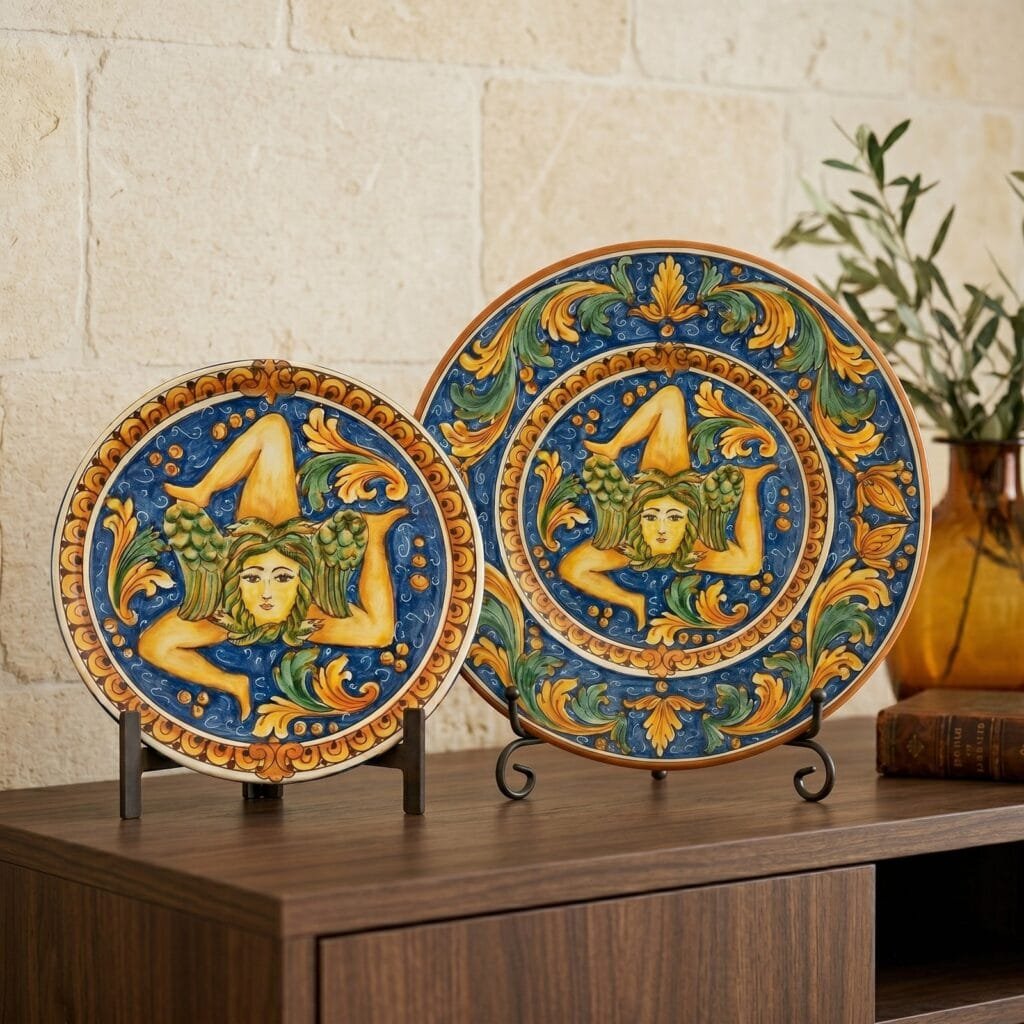
The Greeks had a name for the island, Trinakria, “the one with three headlands.” Sicily is roughly a triangle, and its three points are Capo Peloro near Messina, Capo Passero in the southeast, and Capo Lilibeo at Marsala. The triskeles (Greek for “three legs”), three legs running from a center, fit that shape well: it already appears on coins of Syracuse more than two thousand years ago, and the rulers of the city used it as an emblem.
At some point the two images met. A Roman silver coin struck in 49 BC shows the three legs with a winged Medusa head at the center and an ear of grain between each leg. The coin was issued for the consuls Lentulus and Marcellus, and Marcellus chose the Sicilian design to honor an ancestor who had taken Syracuse in 211 BC. The grain is there because Sicily was one of Rome’s main sources of wheat. Medusa, three legs and grain: this is the Trinacria almost exactly as it appears today.
The symbol came back in the Sicilian revolution of 1848 and in later flags, and on 4 January 2000 the Sicilian Region adopted its official flag: divided diagonally, red above and yellow below, with the Trinacria in the middle. So when someone asks why Medusa is on the Sicilian flag, the short answer is protection. She was put there to guard, the same job she had on Athena’s shield and on the temples of Selinunte. The three legs around her describe the shape of the island: protection and geography sit together in the same symbol.
The Trinacria has a longer history of its own, from Bronze Age symbols to souvenir shops, and we will tell it in a separate article.
Snakes, guardians and gardens
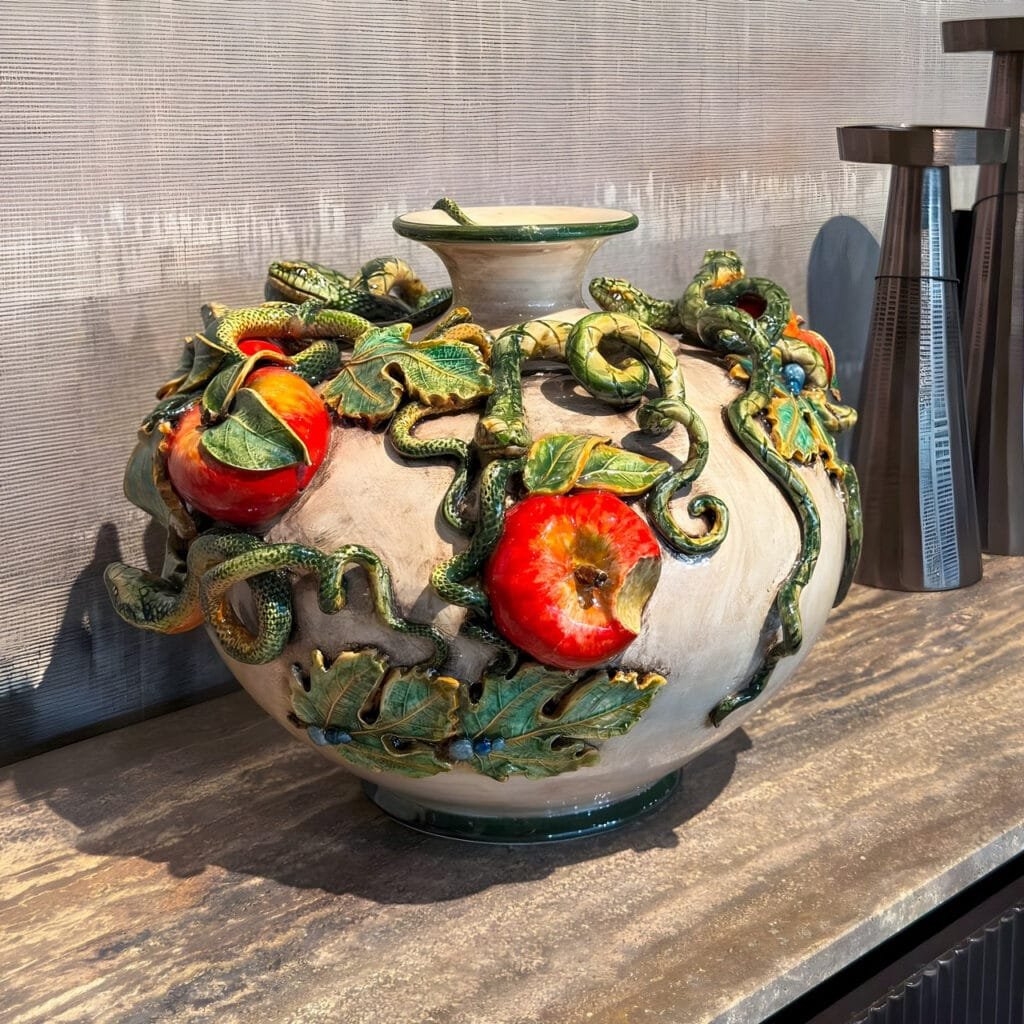
The snakes are what make Medusa recognizable, and they are also what tie her to other stories we tell in clay. On the Trinacria, the snakes in her hair are part of the symbol of the island itself. In our workshop they show up in a second, very different place: the Gardens of Eden line, where red apples, leaves and snakes are modeled in relief and painted by hand on the vases.
Few animals have been read in such opposite ways. In ancient Greece the snake was linked to healing: it was the sacred animal of Asclepius, the god of medicine, and it is still coiled around the staff that serves as the symbol of medicine, including in the logo of the World Health Organization. In Egypt it stood for protection: the rearing cobra on the pharaoh’s crown, ready to strike, was the goddess Wadjet, a sign of the king’s power and of defense against his enemies. With Christianity the same image turns around, and the snake becomes the symbol of temptation and sin, the one that in the Genesis story leads to the expulsion from Eden. Some have feared it and some have worshipped it.
Medusa is on the side of the guardians: her snakes warn and protect, like the pharaoh’s cobra. The snake of Eden is the one that offers the apple, and in the Gardens of Eden line we read it in a positive way, as the start of curiosity and of knowledge. Put a Medusa head next to an Eden vase and you have two opposite readings of the same animal side by side, in the same mother of pearl glaze.
The Sicilian Medusa in Caltagirone ceramics
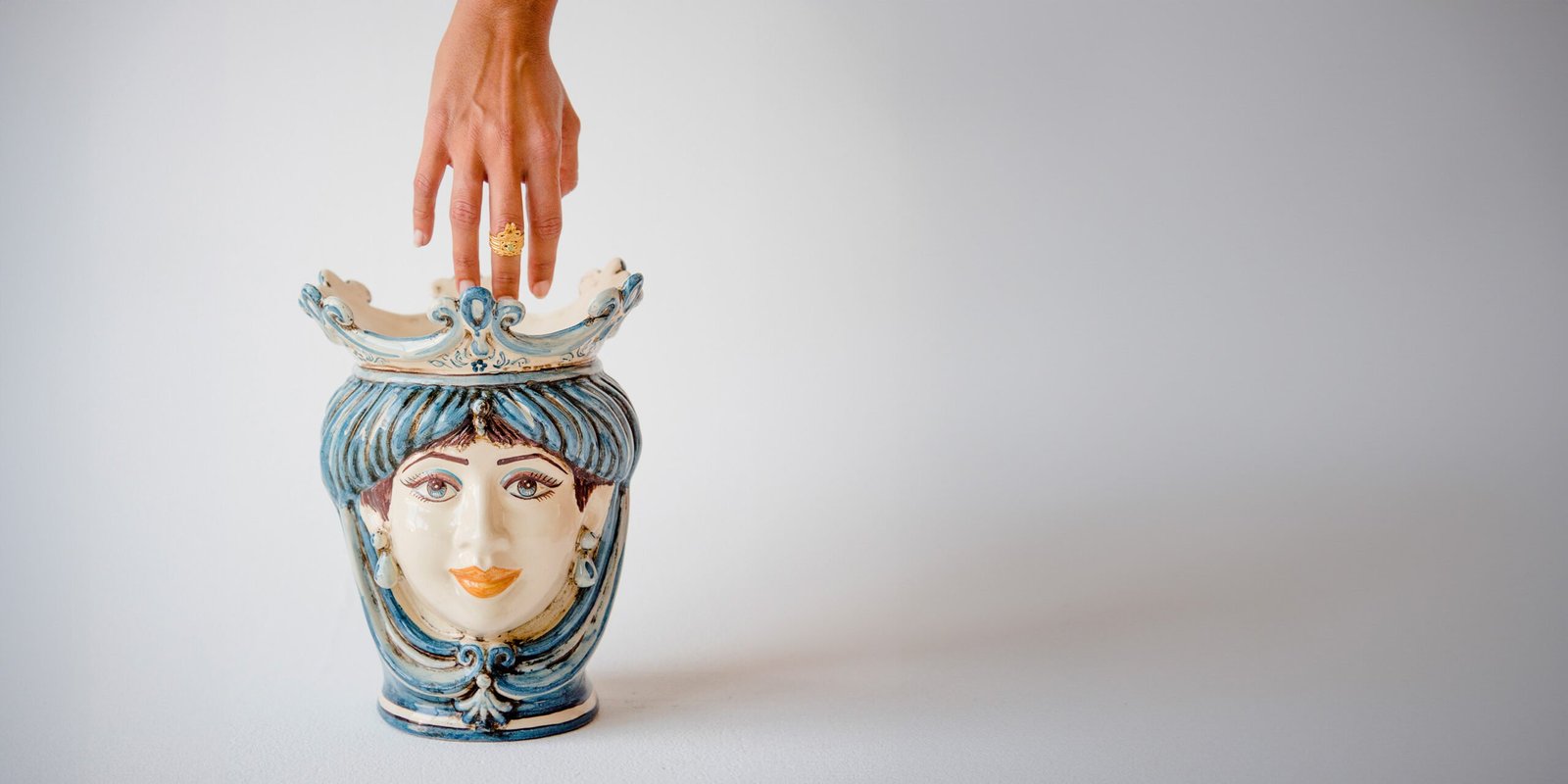
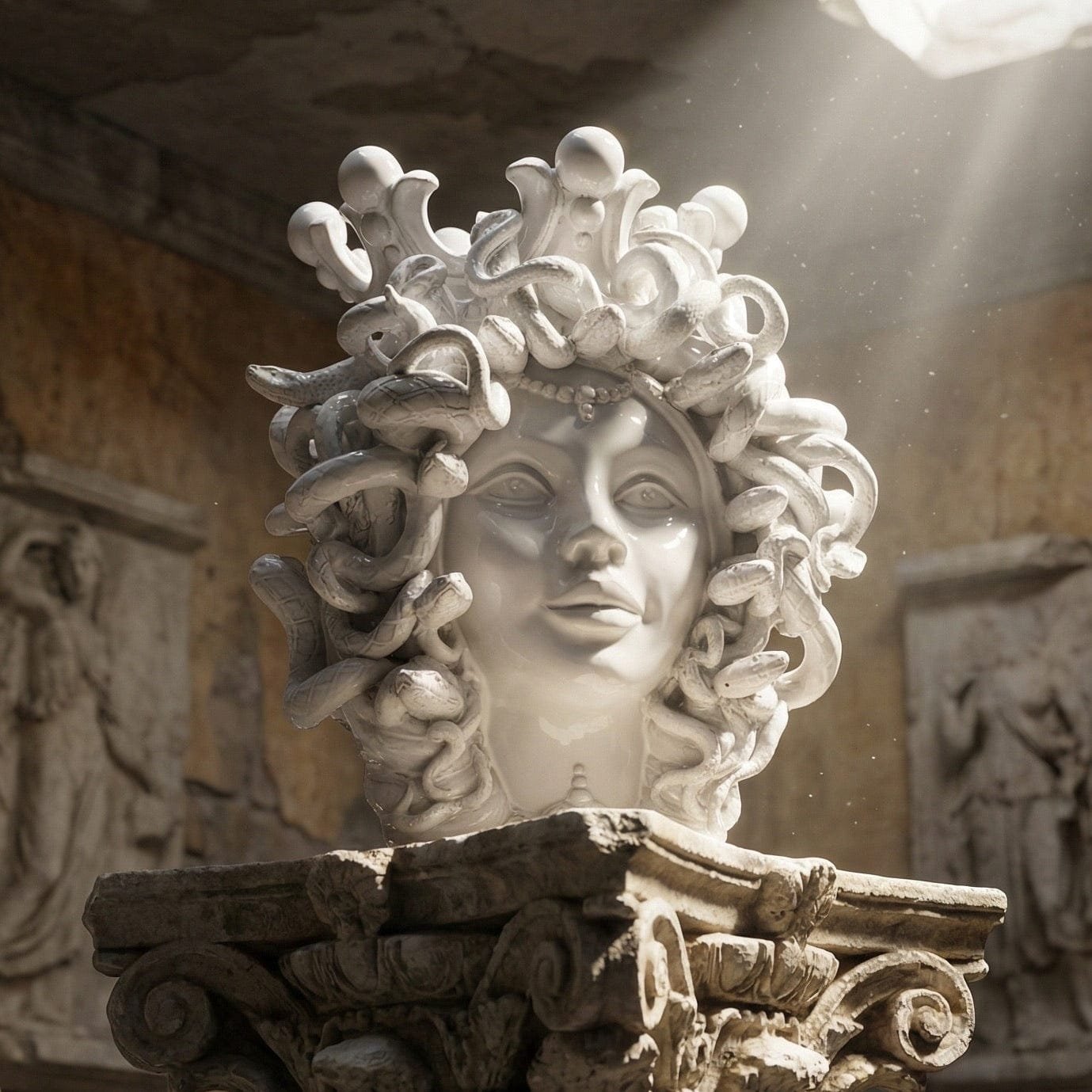
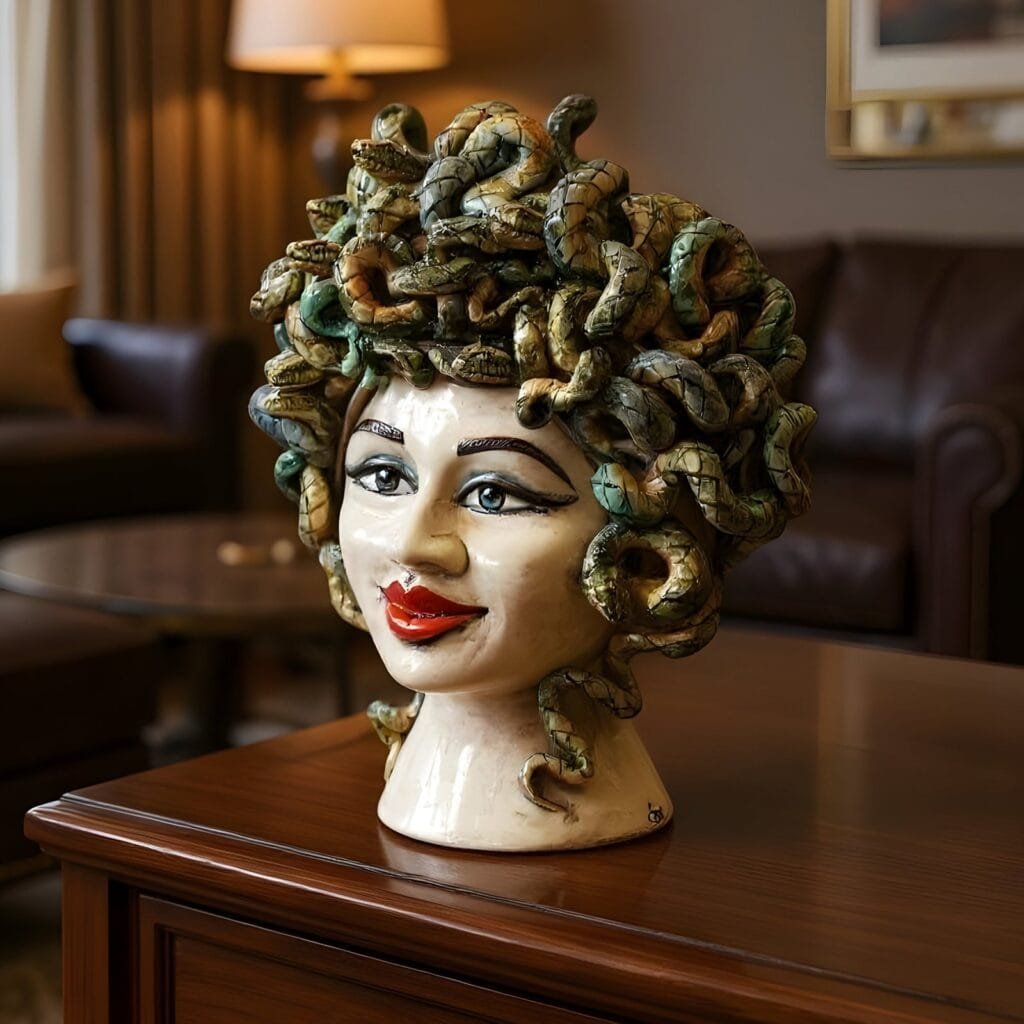
Caltagirone has made glazed pottery for more than a thousand years, and its best known object is the Testa di Moro, the head-shaped vase we describe in our guide to what a Testa di Moro is. Our Medusa heads come from the same idea: a hollow ceramic head, modeled by hand, that can hold flowers or a plant or simply stand on its own. Where a Testa di Moro wears a crown, a turban or a wreath of lemons, the Medusa wears snakes, modeled one by one and laid around the face.
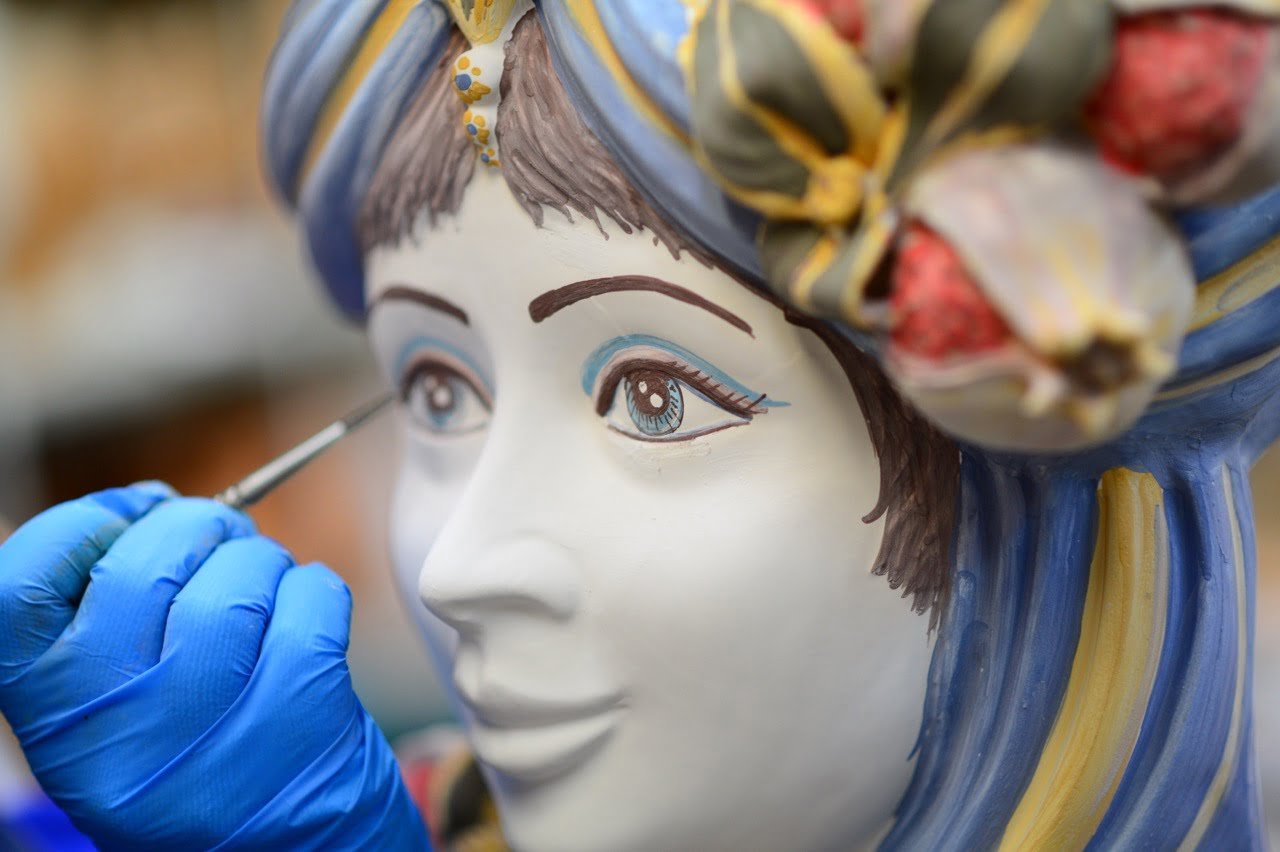
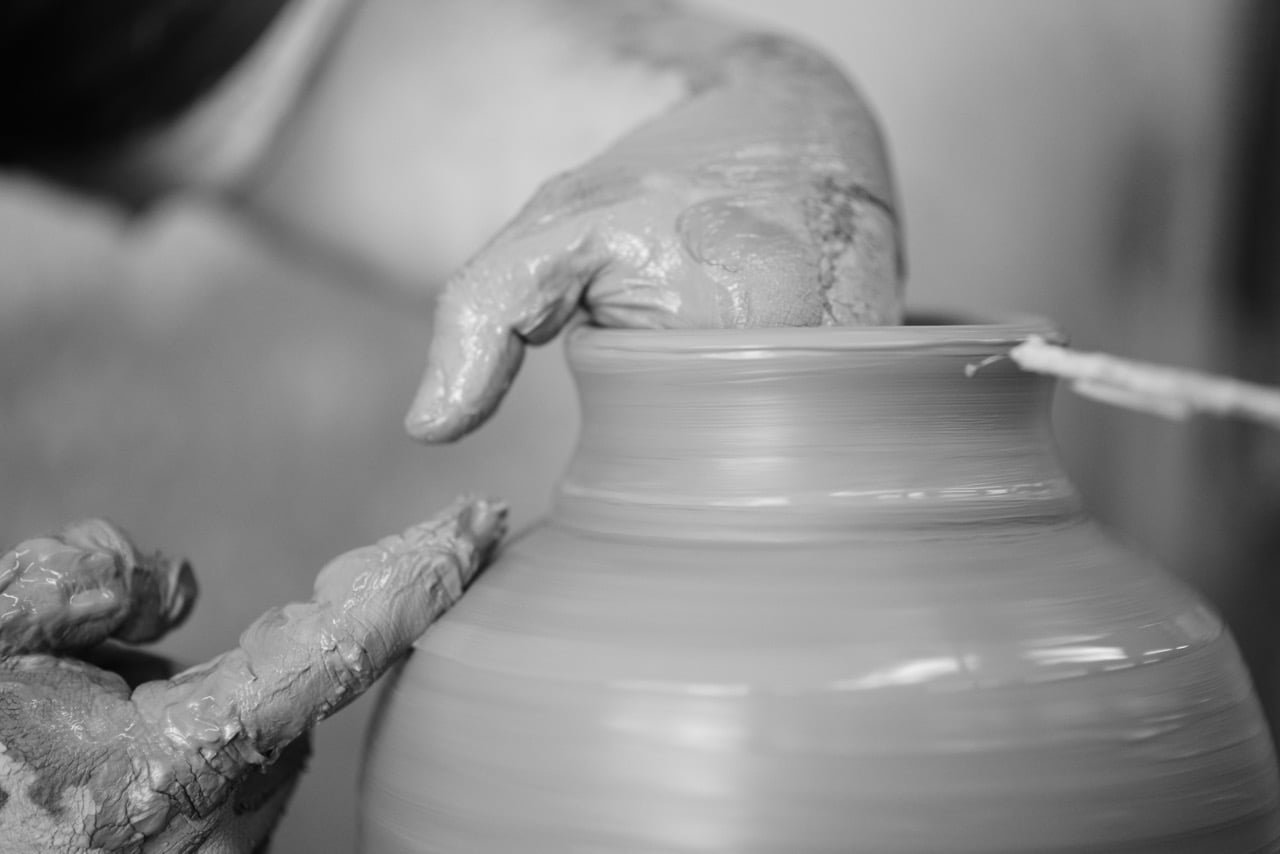
Every head is made the same way as the rest of our work. The clay is shaped by hand and fired once. It is then dipped in glaze, painted, and fired a second time, which fixes the colors for good. Because each snake and each feature is shaped by hand, no two Medusa heads are identical, even within the same model.
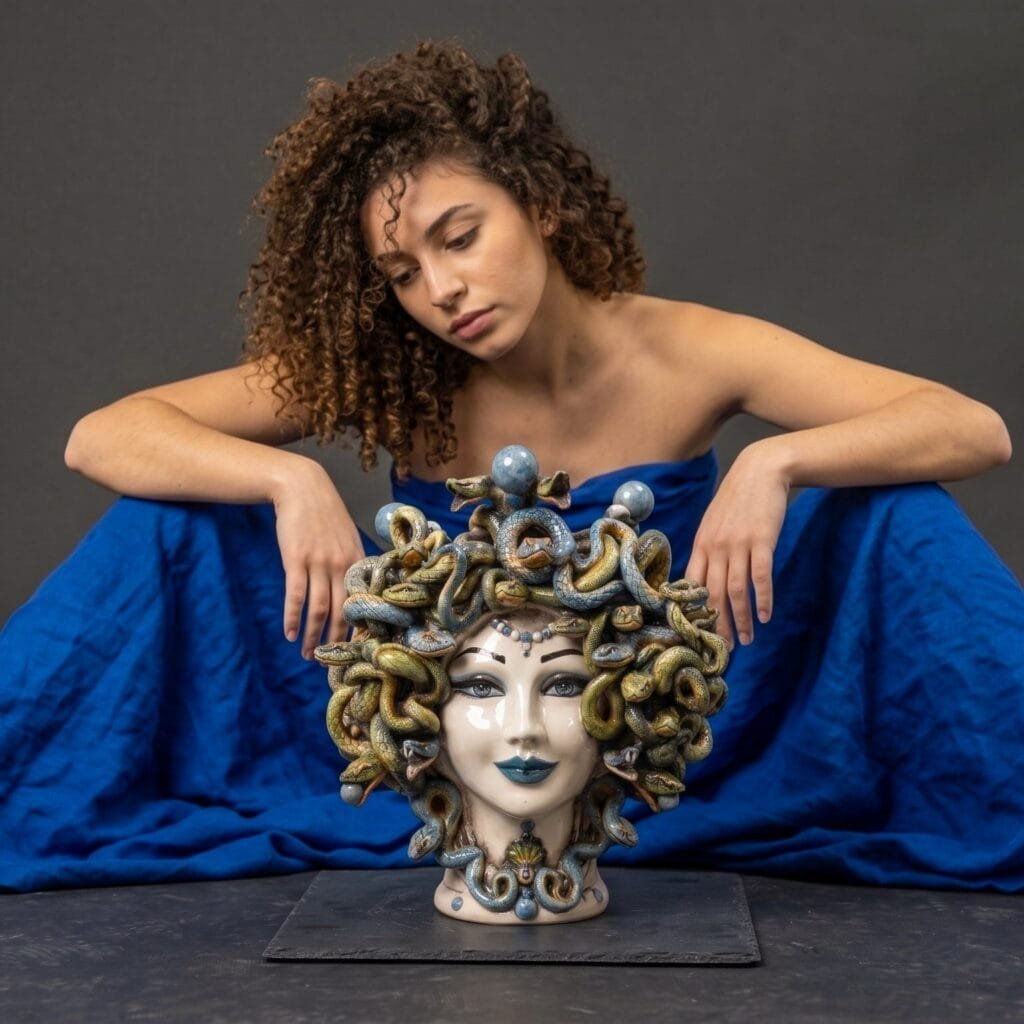
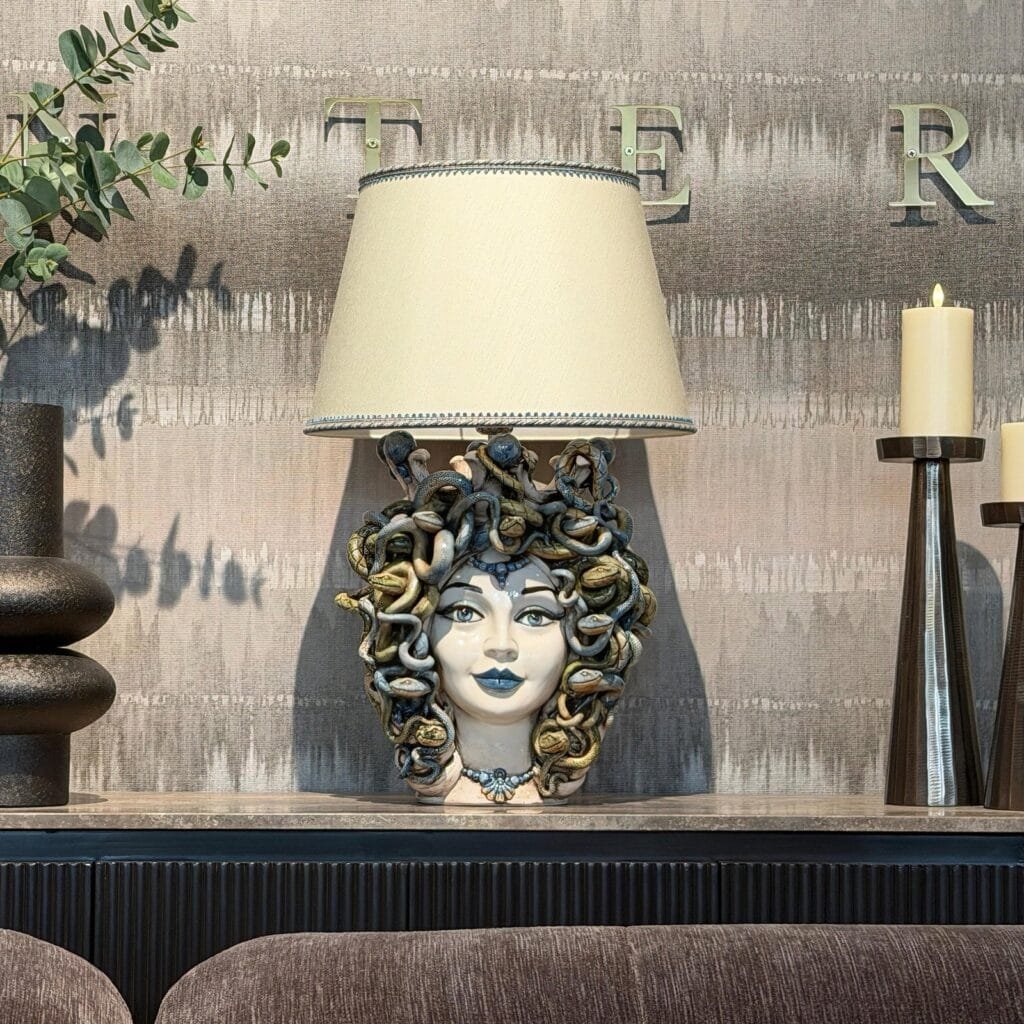
The Medusa collection runs from small heads of 20 cm (about 8 inches) to a 65 cm (about 25 inch) lamp. A few finishes, to give an idea of the range:
- White Line. The 38 cm Medusa in white has no added color at all, so the shape of the snakes carries the whole piece. It is the one we suggest for modern or minimal rooms.
- Antique mother of pearl. An ivory glaze with a soft iridescent sheen and a darker patina that settles into the reliefs, as on the 30 cm Medusa with blue beads.
- Lustre. Metallic glazes such as wisteria, which change color with the light. The 20 cm Medusa in wisteria lustre belongs to the Gardens of Eden line.
- Lamp. The Medusa head lamp, for anyone who wants the guardian to light the room as well as watch it.
For the island’s symbol itself, we paint the Trinacria plate in Ornato Calatino, with Medusa’s face at the center of the three legs and the old floral and geometric decoration of Caltagirone around it, and a smaller Trinacria centerpiece with the legs in gold.
Choosing and placing a Medusa head
A few practical points, from the questions we are asked most:
- Where to put it. Tradition puts the gorgoneion near the threshold, so an entrance hall, a console by the door or a shelf facing the room all keep the old meaning. On a dining table she works better as a single piece than as a pair.
- One or two. Testa di Moro heads are usually sold as a man and woman pair. A Medusa stands alone. If you want a pair, match her with a Testa di Moro in the same finish and size.
- Size. Heads of 20 to 30 cm (8 to 12 inches) suit shelves and side tables. From 38 cm (15 inches) up, she becomes the main piece in the room and needs space around her.
- Flowers and water. Our heads are decorative ceramic. Use a glass or plastic liner if you want fresh flowers with water, and keep them away from frost if they stand outdoors.
- Color in photos. Mother of pearl and lustre change with the light. If the exact shade matters, ask us for a photo of the piece you will receive.
Read more
We have written more about Medusa and the Eden line on the blog of our shop, Italian Pottery: